11.08.2013
Daylight Savings Time
I just turned on lights in the living room because it was getting dark. Hard to tell whether the darkness is due to last weekend's time change or whether it is due to a thick, gray mass of clouds that have settled in over the town.
It always takes me a few days to adjust to the time change in the fall. Mornings, instead of looking like dark nighttime, look instead like faintly-lit gray hazes that make you wonder whether it is morning or evening; early daytime or late-afternoon cloud cover. Afternoons turn dark sooner than expected, and night falls earlier, fooling you into thinking that the day has come and gone more quickly than you expected. It takes me a few days of this to settle into it, to get to a place where I don't feel so disoriented and unsure of the time and rhythm of the day.
And then, as I settle in, something switches in me, and I get it. I remember what winter is like, and I understand the new feel of the day, and I remember the parts of my own self that get tucked away when we spring our clocks forward in March.
In other lifetimes, I gave myself an October threshold for listening to Advent and Christmas music. These days, I hold out until at least the start of November. This year, for whatever reason, I didn't even start thinking about it until last week, when I started loading up playlists onto my iPod in preparation for labor and delivery later this month, and I programmed myself a copious amount of Christmas music for those forthcoming hours.
I forget that we've passed Halloween already, and that Thanksgiving is only a few weeks away. My usual rush to embrace autumn feelings and flavors has been a little slow this year.
Perhaps because while the seasons change around me, and the time changes, and the sun sets earlier in the afternoon, my mind is not on the seasons themselves, or on holidays or traditions or even the bits and pieces of nostalgia that late fall and early winter dig up in me.
For the whole span of time we've lived in Iowa, time has been pressing ahead toward only one thing: the birth of this much-loved, much-awaited hedgehog of a baby, whose due date is just two weeks away. Thanksgiving this year will either be a celebration of a very new newborn, or the last few days of a very very uncomfortable pregnant lady. Christmas feels like forever away, because something as big as HAVING A BABY needs to happen between now and then. The whole fall has been a time of talking about this eventual baby and making initial plans and preparations, except that we are now in the last days, and the things that needed to get done "sometime this fall" now need to get done today and this week and as soon as we can manage them.
Today, though, Daylight Savings Time finally caught up to me in a useful way. As I sat here on the couch, watching the grayness of the afternoon creep in through the windows, I felt this urge for something to happen. Tired of waiting, I felt ready for a holiday, or ready for some nostalgia. Ready to knit and make soup and do autumnal things. Ready to scoff a little less at the Thanksgiving and even Christmas commercials on TV. I am ready for something to happen. Ready to meet this baby, or to eat some stuffing, or to start sorting through the Christmas decorations that we might put up right after Thanksgiving with family members who will be coming to see us. I'm okay with the wind blowing outside, and with the fact that it might be time to pull out my winter coat, even if I can't zip it up right now. I am ready for something to happen. Babies, holidays, families, cozy nights, anything to reclaim a space for myself that is no longer a space of mere waiting, but a space of anticipation and joy and movement.
Maybe being nine months pregnant makes me a bit of a crazy-lady. Because I'm not sure how a gray afternoon can somehow make me excited rather than depressed. But maybe the weather just reminds me that the seasons are again changing, and that nothing actually stands still in life, and when the quiet of waiting starts to drive you a little nuts, even the world outside can remind you that change is always on the horizon, and those things that you've been waiting for will indeed come, and all the days that you've been counting will indeed lead to something new and interesting and beautiful.
10.07.2013
20 Pentecost: Faith enough
![]() |
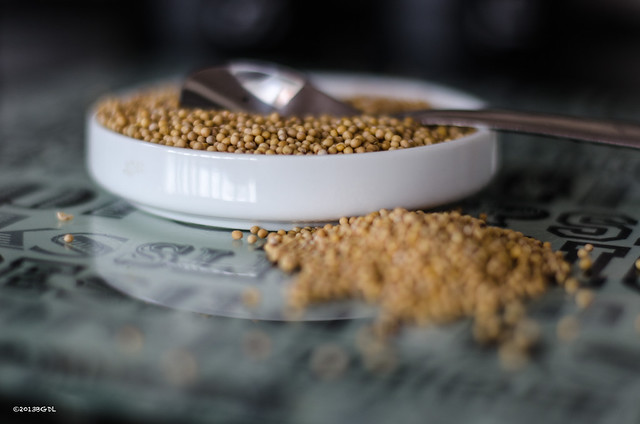
| "Mustard Seeds" by BGDL, on Flickr |
Jesus said to his disciples, "Occasions for stumbling are bound to come, but woe to anyone by whom they come! It would be better for you if a millstone were hung around your neck and you were thrown into the sea than for you to cause one of these little ones to stumble. Be on your guard! If another disciple sins, you must rebuke the offender, and if there is repentance, you must forgive. And if the same person sins against you seven times a day, and turns back to you seven times and says, 'I repent,' you must forgive."
The apostles said to the Lord, "Increase our faith!" The Lord replied, "If you had faith the size of a mustard seed, you could say to this mulberry tree, 'Be uprooted and planted in the sea,' and it would obey you.
Who among you would say to your slave who has just come in from plowing or tending sheep in the field, 'Come here at once and take your place at the table'? Would you not rather say to him, 'Prepare supper for me, put on your apron and serve me while I eat and drink; later you may eat and drink'? Do you thank the slave for doing what was commanded? So you also, when you have done all that you were ordered to do, say, 'We are worthless slaves; we have done only what we ought to have done!'"
---
Every time I read this gospel, a hymn-verse leaps into my head. The disciples say "increase our faith," and my mind goes to the communion hymn, "Thee We Adore." Maybe you know it. The third verse goes like this:
Fountain of goodness, Jesus, Lord and God,
cleanse us, O Christ, with thy most cleansing blood:
increase our faith and love, that we may know
the hope and peace which from thy presence flow.
(Thee We Adore, O Hidden Savior, ELW 476)
Increase our faith and love, that we may know the hope and peace which from thy presence flow.
It's a prayer that many of us have likely prayed, in so many words, just like the disciples who cried out to Jesus, "increase our faith!"
It was October of last year. I was lying in bed at night, processing the news that our third attempt at IVF had failed. And for the first time in our many years of trying to have a baby, I finally got fed up. I laid awake in bed, praying...if you could call it praying. Mostly, I just said angry things to God. I said words inside my head that I’d never say out loud, in polite company or otherwise. I was hurt, I was angry, I was tired. And I wondered whether I had faith enough to keep going, to keep trying and hoping.
"Increase my faith and love," I prayed, in far angrier language, "that I might know hope and peace in this struggle."
Have you ever had nights like those? When you lie awake wondering if you really have faith and strength enough to press forward? When your doubts and fears seem to outweigh your faith? When the calling set before you by God seems to be just too difficult to carry out?
Throughout this season of Pentecost, the green season of growing in faith and discipleship, Jesus has been telling his disciples, over and over again, about the struggles of faith and discipleship: To be a disciple, you give up the comforts of home, and you put the concerns of the kingdom of God ahead of your other priorities. Being a disciple means carrying the cross, giving up possessions, and recognizing that the cost of discipleship is your very life itself.
Today, Jesus again instructs the disciples to do some hard things. “Follow me,” Jesus said, “and don’t give in to temptations to stray from working for the kingdom. Follow me in protecting the vulnerable. Follow me in confronting sin and injustice. Follow me in forgiving one another, and forgiving one another over and over again.”
Like the disciples, we are no stranger to the reality that faith and discipleship sometimes ask us to do very difficult things. Public things, like feeding the hungry, forgiving as we’ve been forgiving, putting the needs of others ahead of our own needs. And personal things, like moving forward through grief or confusion or tough personal circumstances.
Any one of these things has the power to keep us up at night, whether we are heartsick over the needs of our world or paralyzed by the needs of our own souls. And in those awake-at-night moments when we feel overwhelmed by the paths life has set before us, we, with the disciples, cry out, “Increase our faith!”
Because maybe, we believe, maybe if we had more faith, all the hard stuff would be easier. Maybe, if we had more faith, we could be better people. Maybe, if we had more faith, we could actually do good in the world. Maybe, if we had more faith, we’d have more answers and more certainty. Maybe, we think to ourselves, there is this certain level of faith, a certain volume of faith that needs to fill us up before we have the courage and strength to go forward in whatever God calls us to do or endure.
Everything else in life seems to function this way. You need a full gas tank before you can head out on a road trip, and you need a certain level money in your savings account before you can buy a house, and you need a certain number of years in your current position before you can earn a promotion, and you need a certain level of education or training before you can do certain tasks. We're used to this idea that you need a particular amount of something before you can benefit from it.
And so we look at faith the same way. Either as a practical concern or a matter of desperation. "Increase our faith!" we cry out to God, because it's hard for us to ever believe that we have enough of it.
The problem with this line of thinking is that it turns faith into a commodity rather than a gift. It turns faith into a bargaining tool, where we think we can trade a certain amount of faith for some outcome that we desire from God. It turns faith into a weird mystical protein shake that we drink to bulk ourselves up before we do the heavy lifting of sharing the gospel with the world.
This "increase in faith" mentality makes faith all about us instead of all about God; all about our needs instead of all about God's faithfulness.
This is where Jesus steps in with the reminder that even a speck of faith the size of a tiny mustard seed is plenty. More than enough.
Because the thing about faith is that it really isn't about us. It's about God. In our dark nights of the soul, it’s not actually the quantity of our faith that gets us through, it is the whole and complete faithfulness of God to us that sustains us. And when we are called to do hard things like forgiving and reconciling and feeding and healing, it’s not the strength of our faith that helps us carry out those tasks, it is the whole and complete faithfulness of God to us that empowers us.
Jesus tells the disciples that the tiniest speck of faith is enough to answer God's calling. That even the teensiest scrap of faith is plenty to act faithfully in the world. Hence his little discourse on slaves doing only what they ought. He’s telling the disciples that they don’t need superhuman faith to answer God’s call to act faithfully in the world.
Because there is no rule that says you have to have all of your own baggage figured out before you can offer a listening ear to a friend in need. And there's no prerequisite that you have to have forgiven yourself before you can forgive others around you. And you can feed the hungry even if you are still feeling spiritually hungry. And you can tell somebody that God loves them even if you aren't quite sure that you yourself are so loveable.
Jesus calls the disciples and us to follow in his way of mercy and love, but he doesn't tell us that we need to be spiritual giants before we can do that.
Instead, he assures us that a speck of faith the size of a mustard seed is plenty of faith to live as disciples. He reminds us, deep in our hearts, that a taste of bread and a sip of wine and a droplet of water are more than enough to carry us through each week.
Because even a tiny, feeble faith can cling to the promise that God is faithful, and loves his whole creation; that there is nothing, not height or depth or anything in all creation that can separate us from the love of God in Christ Jesus; that by God's grace alone we live and move and have our being.
Friends, God is bigger than all of your fears, all of your doubts, all of your hesitations. God is faithful, even when we aren't. Even your smallest seed of faith in our faithful God means that you have the strength to face tomorrow, and the power to live faithfully for the sake of the world. For it is indeed by grace that you have been saved and will be sustained, through faith, whether big or small, and this is not your own doing, it is the doing of God, who promises always to see you through each new morning, for each day is a new reminder of resurrection, and a new sign of hope for you, for me, and for all creation.
9.17.2013
Chasing utopia...and losing yourself
I am a perfectionist.
I have been for a very long time. Perfectionism manifests itself in me in various ways: being a type-A, detail oriented person; having manic swings where I have to ORGANIZE EVERYTHING RIGHT NOW; feeling guilty if I have not accomplished what I believe to be my best work; feeling hurt and ashamed by critique, no matter how kind or valid.
This is not to say that I am in perfectionist mode all the time. I make messes, I can be a total flake, I often have the urge to ignore areas of life and work that I'm not good at.
In general, my perfectionism means that my outlook on life is based on seeking ways to make things as good as possible. Some days, this comes across as optimism and energy. Other days, this comes across as frustration and feelings of inadequacy.
Put another way, I am a person who is always seeking utopia in some fashion, big or small. If I can just arrange my office in the perfect, most beautiful, most organized way, then I have created a peaceful utopia amidst the bustle of everyday church life. If I can just bring a few really good ideas to a committee and see them through to success, then I have created an affirming utopia where we are all empowered, and where I am in good graces. If I can wake up early on a sunny Saturday morning and walk first to the farmer's market and then to my favorite, idyllic coffee shop, then I have created a slice of small-town utopia that might trump whatever I loved or miss about suburban life.
I mean, I have this tendency to believe that if I put things together just-so, then I can create and appreciate a perfect little world around me, and be very, very happy.
The problem is that this doesn't actually work in real life.
It's not just that my office gets messy and disorganized sometimes, or that even my best efforts sometimes receive due critique. It's not just that sometimes I oversleep my alarm on Saturdays. And it's not even that the world is an unpredictable place, and I can't always control everything (as much as I'd like to).
The problem with endlessly seeking utopia is that you lose yourself in the process. When all of my time is spent organizing perfect parameters for my life, I don't actually get around to living that life.
Take yesterday, for example. It'd been a sleepy, frustrating sort of day. I spent the afternoon looking forward to going home, crashing on the couch, and knitting to the sound of silly television shows.
I got home, and pulled out my basket of knitting, but first decided that I was hungry and needed a good snack (a honeycrisp apple and peanut butter...yum). Once I had the perfect snack, I went back to the couch, and then had to find the perfect channel on TV before I could settle in to start knitting (that took two full cycles through all the channels, just to make sure I wasn't missing anything that happened to be at commercial during the first pass). And just in case somebody at church really needed me (and I wouldn't want to let anybody down), I probably needed to grab my phone and check my email one last time. Basically, it took me forever to get around to knitting, and I only finished a couple rows before it was time to start thinking about dinner.
Because everything needed to be just-so. Because I had to be perfectly set-up for my picturesque late afternoon of knitting. And in the process of setting myself up, I wasted all of the time I could have simply been knitting.
That's the thing about utopia. Work too hard to create your perfect world, and you never actually get around to enjoying it. Because you've put too much pressure on yourself to be perfect instead of being happy.
It's a lesson about life, surely, and about ministry. And about starting families and taking care of houses and doing all of that grown-up sort of stuff. We think that perfect will pave the way to happy. But perfect really just delays happy until sometime in the unknown future.
Which is not exactly how I want to live. Nor is it how my faith encourages me to live.
In Matthew 6 Jesus says, "Therefore I tell you, do not worry about your life, what you will eat or what you will drink, or about your body, what you will wear. Is not life more than food, and the body more than clothing?...But strive first for the kingdom of God and his righteousness, and all these things will be given to you as well. So do not worry about tomorrow, for tomorrow will bring worries of its own. Today's trouble is enough for today."
And in Revelation 21 I read, "Then I saw a new heaven and a new earth; for the first heaven and the first earth had passed away, and the sea was no more...And the one who was seated on the throne said, 'See, I am making all things new.'"
We're not talking self-made utopia here. We're talking about trusting God in the stuff of today, and trusting God in the work of new, perfect creation. So how might I - how might each of us! - live in this space where we trust God more than we trust ourselves, where we stop trying to make things perfect, and instead focus on appreciating and loving this day and this blessed moment? Might we find that we are happier? More fulfilled? Less anxious?
I suspect so.
I must myself remember: I am not called to perfection. I am called to be faithful and gracious, generous and kind. And there is a big difference between those things.
I have been for a very long time. Perfectionism manifests itself in me in various ways: being a type-A, detail oriented person; having manic swings where I have to ORGANIZE EVERYTHING RIGHT NOW; feeling guilty if I have not accomplished what I believe to be my best work; feeling hurt and ashamed by critique, no matter how kind or valid.
This is not to say that I am in perfectionist mode all the time. I make messes, I can be a total flake, I often have the urge to ignore areas of life and work that I'm not good at.
In general, my perfectionism means that my outlook on life is based on seeking ways to make things as good as possible. Some days, this comes across as optimism and energy. Other days, this comes across as frustration and feelings of inadequacy.
Put another way, I am a person who is always seeking utopia in some fashion, big or small. If I can just arrange my office in the perfect, most beautiful, most organized way, then I have created a peaceful utopia amidst the bustle of everyday church life. If I can just bring a few really good ideas to a committee and see them through to success, then I have created an affirming utopia where we are all empowered, and where I am in good graces. If I can wake up early on a sunny Saturday morning and walk first to the farmer's market and then to my favorite, idyllic coffee shop, then I have created a slice of small-town utopia that might trump whatever I loved or miss about suburban life.
I mean, I have this tendency to believe that if I put things together just-so, then I can create and appreciate a perfect little world around me, and be very, very happy.
The problem is that this doesn't actually work in real life.
It's not just that my office gets messy and disorganized sometimes, or that even my best efforts sometimes receive due critique. It's not just that sometimes I oversleep my alarm on Saturdays. And it's not even that the world is an unpredictable place, and I can't always control everything (as much as I'd like to).
The problem with endlessly seeking utopia is that you lose yourself in the process. When all of my time is spent organizing perfect parameters for my life, I don't actually get around to living that life.
Take yesterday, for example. It'd been a sleepy, frustrating sort of day. I spent the afternoon looking forward to going home, crashing on the couch, and knitting to the sound of silly television shows.
I got home, and pulled out my basket of knitting, but first decided that I was hungry and needed a good snack (a honeycrisp apple and peanut butter...yum). Once I had the perfect snack, I went back to the couch, and then had to find the perfect channel on TV before I could settle in to start knitting (that took two full cycles through all the channels, just to make sure I wasn't missing anything that happened to be at commercial during the first pass). And just in case somebody at church really needed me (and I wouldn't want to let anybody down), I probably needed to grab my phone and check my email one last time. Basically, it took me forever to get around to knitting, and I only finished a couple rows before it was time to start thinking about dinner.
Because everything needed to be just-so. Because I had to be perfectly set-up for my picturesque late afternoon of knitting. And in the process of setting myself up, I wasted all of the time I could have simply been knitting.
That's the thing about utopia. Work too hard to create your perfect world, and you never actually get around to enjoying it. Because you've put too much pressure on yourself to be perfect instead of being happy.
It's a lesson about life, surely, and about ministry. And about starting families and taking care of houses and doing all of that grown-up sort of stuff. We think that perfect will pave the way to happy. But perfect really just delays happy until sometime in the unknown future.
Which is not exactly how I want to live. Nor is it how my faith encourages me to live.
In Matthew 6 Jesus says, "Therefore I tell you, do not worry about your life, what you will eat or what you will drink, or about your body, what you will wear. Is not life more than food, and the body more than clothing?...But strive first for the kingdom of God and his righteousness, and all these things will be given to you as well. So do not worry about tomorrow, for tomorrow will bring worries of its own. Today's trouble is enough for today."
And in Revelation 21 I read, "Then I saw a new heaven and a new earth; for the first heaven and the first earth had passed away, and the sea was no more...And the one who was seated on the throne said, 'See, I am making all things new.'"
We're not talking self-made utopia here. We're talking about trusting God in the stuff of today, and trusting God in the work of new, perfect creation. So how might I - how might each of us! - live in this space where we trust God more than we trust ourselves, where we stop trying to make things perfect, and instead focus on appreciating and loving this day and this blessed moment? Might we find that we are happier? More fulfilled? Less anxious?
I suspect so.
I must myself remember: I am not called to perfection. I am called to be faithful and gracious, generous and kind. And there is a big difference between those things.
9.11.2013
16 Pentecost: Counting the cost
![]() |
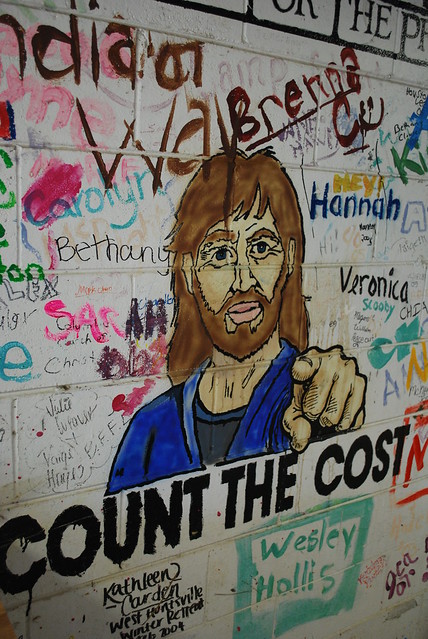
| "Count the Cost" by Laura Megan Photography, on Flickr |
Now large crowds were traveling with [Jesus]; and he turned and said to them, "Whoever comes to me and does not hate father and mother, wife and children, brothers and sisters, yes, and even life itself, cannot be my disciple. Whoever does not carry the cross and follow me cannot be my disciple. For which of you, intending to build a tower, does not first sit down and estimate the cost, to see whether he has enough to complete it? Otherwise, when he has laid a foundation and is not able to finish, all who see it will begin to ridicule him, saying, 'This fellow began to build and was not able to finish.' Or what king, going out to wage war against another king, will not sit down first and consider whether he is able with ten thousand to oppose the one who comes against him with twenty thousand? If he cannot, then, while the other is still far away, he sends a delegation and asks for the terms of peace. So therefore, none of you can become my disciple if you do not give up all your possessions.
---
It wasn’t too long ago that I found myself in the midst of a conversation about sales tax, of all things. (Riveting, I know. I hang around with terribly interesting people.) The conversation went something like this:
“Wouldn’t it be nice if sales tax was already factored into the cost of the things we buy? Doesn’t matter if it made prices look all funny, like $22.56. It would just be so much easier to know up front what things were really going to cost when you got to the register.”
And then we went on to think fondly of the handful of states in our country that don’t charge sales tax on necessities like food and clothing, not because those goods are necessarily cheaper to buy, but because there is no mystery. The cost is laid out, and there’s nothing more to it.
Counting the cost is something that we do all the time. Often, counting the cost means taking a look at what we think we can afford, and then choosing accordingly. Like how sometimes my beverage choice at Java John’s is determined not by what I want to drink, but by how much cash I have in my wallet. We count the cost when we think about spending money, or time, or energy, or commitment, and the question at stake is always, “Is it worth it?”
Which leads us to today’s gospel. Jesus, like a sales-tax-included pricetag, lays out the full cost of discipleship to the crowds who seek to follow him. He tells them exactly what it might cost them if they choose to walk in his footsteps.
We have to be careful when we approach today’s gospel. On first glance, it is easy to read it as a list of conditions that Jesus requires us to meet before we can become disciples. As if Jesus is saying, “first go renounce your family, then go give up all of your stuff, and then renounce life itself, and when you’ve done all of those things, come back to me and we can talk about your place among my disciples.” It is easy to misread this passage and come to believe that the cost of discipleship is an up-front cost that we somehow need to pay before we can join Jesus’ team.
But that way of thinking is pretty much opposite of the way that God works. God didn’t make us promise to cherish one another and the whole creation before he decided to craft the universe, and when we failed miserably at both of those things, God didn’t make us promise to be good or even to be sorry before he decided to show up in our world in the flesh and walk with us in the person of Jesus. Jesus didn’t make us promise to love him or believe in him before he choose to die for us. And God certainly didn't wait until the world was ready and receptive to raise Jesus from the dead and usher in the promise of new creation.
In the story of our faith, God is always the one who acts first, and God is always the one who loves freely, without making us first check the little box that says we accept his terms and conditions.
And so there's something else going on in today's gospel reading, something different than a message of "sacrifice everything for Jesus or else."
Because what we really have in the gospels is this guy Jesus who shows up on the scene, and starts telling people, “follow me.” He is this rebel prophet and teacher, who gets the religious leaders all riled up with some regularity, and he heals people and does these crazy miracles, and he teaches some pretty incredible stuff about forgiveness and mercy, and he keeps talking about this “kingdom of God,” and as he goes along, he keeps saying “follow me” to people, regardless of their place in life. And he’s interesting enough that people actually drop everything to follow him around.
Which sounds great until you realize that people have left behind families and obligations and livelihoods and possessions to follow Jesus. And that's a really big deal. Leaving behind your family, in Jesus’ time, especially if you were a man, meant leaving them without security, without status, and without protection. Leaving behind your job left you without income. Leaving behind your obligations to your town or clan or synagogue left you with a bunch of angry and confused people on your hands.
Now notice that Jesus doesn’t discourage people from doing all of this. He doesn’t send them home, saying “your family needs you” or “you should probably at least give your boss two-weeks’ notice before you quit your job.” He instead simply makes the point that you’d better be prepared, because following him is likely to come with a cost, because ushering in God’s kingdom of justice and peace and forgiveness and mercy is a big deal, and doing the work of this kingdom is pretty amazing, but it’s going to rock the boat.
And so when Jesus talks about calculating the cost of discipleship, I believe that he's actually just preparing us for the reality that sometimes God calls each of us to such an irresistible calling that everything - everything - we thought was important becomes less important. That sometimes when God moves our hearts to live as disciples, we become oddly willing to leave everything else behind. And that looks really really weird to the world. Because we aren't terribly used to this idea of sacrifice.
Matt and Kristi fell in love over organic chemistry homework. They graduated college together, went to medical school, started a family, and all the while knew, deep in their hearts, that God had a calling for them. So just two days ago, after months of preparation, Matt and Kristi and their two young girls left their Rochester home, boarded a plane, and two long flights later landed in Ethiopia, to begin their first two-year term as medical missionaries in a remote village about four hours from the closest city. Four hours from their mail, four hours from their mission headquarters, four hours from internet. In order to follow God's call, they had to bid farewell to sisters and cousins and parents. They had to sell many of their belongings, and pack and store whatever was left. For them, their call to discipleship happened just like Jesus predicted: giving up family and possessions and livelihood for the sake of the gospel. But note the order of operations. First came the call, then came the sacrifice, and not the other way around. Counting the cost happened only after saying yes to God’s call to discipleship.
So the question at hand in today’s gospel is NOT, “What are you willing to give up for the sake of the gospel?” but rather, “What is it about the gospel that makes you willing to give up everything for its sake?”
Is it the assurance of God’s unconditional love and forgiveness? Is it the hope of a new creation? Is it the promise of everflowing grace and mercy? Is it the expectation of perfect peace and wholeness for our world? Is it the wonder of abundant, eternal life?
What about the gospel is so irresistible to your heart that you’re willing to make sacrifices for it?
For author Sara Miles, a forty-plus year atheist, the irresistible gospel showed up as a piece of communion bread, offered freely and exactly at God’s right time, and the call of the gospel was so strong that she not only found faith, but used that faith to begin a food pantry out of her new church, against all odds.
For Martin Luther, the irresistible gospel showed up as a new understanding of the words, “for it is by grace you have been saved, through faith, and not by works,” and the call of the gospel was so strong that he took the risk of reforming the church, and starting a legacy that has followed him five hundred years down the road.
For Matt and Kristi, the irresistible gospel showed up as a summer mission project in Mexico that connected their faith and their medical training in new and enlivening ways, and the call of the gospel was so strong that they’ve shipped their family halfway across the world to offer health and wholeness in God’s name.
Maybe the call of the gospel is clear to you. Maybe you’re still searching. But wherever we are on our faith journey, we yet gather here to hear about the fullness of God’s love and grace, and we keep splashing around the waters of forgiveness, and we keep breaking the bread of life, and we keep sharing the light of Christ, that the gospel message might somehow, someday become irresistible to each and every one of us.
And if there’s anything at all that I can say to you with certainty this morning, it is that the God who has begun the good work of faith in each of us promises to see it through to the day of completion. And whatever it is about the gospel that has drawn us to this place, however feebly, God will sustain us in whatever he calls us to do in his name.
So count the cost if you must. Add up the columns, and compare gains and losses if need be. But know that there is only life to be gained from answering God's call to embody his love and compassion in the world. Know that this life of faith is worth whatever it may cost you. Because Jesus says to each of us, “I’ve already paid the cost in full. So follow me, because there is hope and forgiveness and wonder and boundless love to be found along this road I call you to travel. Trust me. Follow me. It will always be worth it.”
Subscribe to:
Posts (Atom)