A few weeks ago, a strange convergence of faith-related things happened in the public eye.
Fred Phelps, founder of Westboro Baptist Church, died in hospice care.
Mark Driscoll, outspoken writer and pastor of Mars Hill Church in Seattle, Washington, posted a public apology letter for some of his actions in leading his church.
World Vision, a Christian child sponsorship and world relief organization, changed their hiring policies to open employment to those in same-sex marriages...and then promptly reversed their decision.
I could spend many words on any one of those three events. We have the death of a man who led his congregation in truly hateful acts, picketing and protesting funerals of soldiers and celebrities, standing outside public events with damning anti-gay signs. We have an apology letter and a "signing-off" of social media from a man who has said terrible things about women, and especially women in leadership, though his apology seems most aimed at his own actions within his own church. And we have a relief organization who, whether you agree with their methods or not, does much good in the world, who opened the doors to more just hiring practices, and then, under pressure from donors, closed that door, and in the process still managed to lose much funding...funding that is crucial to saving the lives of children and families around the world.
What has been most interesting in watching these stories unfold is the gracious response to all three stories by those who, if we're being honest, were most theologically inclined to engage in a bit of Schadenfreude.
I watched Christians of all stripes pray for Mr. Phelps's peaceful passing, and for comfort for his family and his congregation. I watched progressive Christians offer up support and kindness for Marc Driscoll. I watched Christians in support of same-sex marriage say things like "if we think it is wrong for Evangelical organizations to pull support for World Vision when they opened up their hiring practices, then it is equally as wrong for us to pull support when they closed them."
And I was amazed at all this grace.
For as much as I believe I am a compassionate, caring person, I also know that I am stubborn. And when I get into the thick of things with those with whom I disagree, I can become oppositional for opposition's sake. And it is in times like that when I need the Holy Spirit, or my conscience, or someone who knows me well, to gently tap me on my shoulder and whisper into my ear, "Grace, Melissa. Grace."
And when I slow down enough to take a breath from my own stubbornness, then I find myself doing things like rooting for the underdog (or at least feeling empathy for them), taking seriously the real hurts of others (even if they are caused by inaccuracies or misunderstandings), looking for the best in others, and taking seriously the notion that even those with whom I disagree are often also working out of deep-seated convictions and good intentions.
I preached a couple weeks ago about God's call for us to seek loveliness in one another and in our world, rather than setting our sights on one another's sins, limitations, or brokenness. I am thankful for all those in my life who model grace; who look for the holiness in one another, who remember that God has called us all "beloved."
So what does grace look like? I think it looks like taking each other seriously. Taking each other at our word. Looking for points of agreement rather than disagreement. Listening often and listening well. Being bound to one another by our shared humanity, by our shared neediness, by our shared salvation. It's like compassion plus empathy plus being self-aware enough to realize that you aren't right all the time and you certainly don't always need to "win."
May you see grace in one another today, and feel grace extended to you, and be graceful and grace-filled in the people and places you touch.

Showing posts with label simple living. Show all posts
Showing posts with label simple living. Show all posts
4.09.2014

9.17.2013
Chasing utopia...and losing yourself
I am a perfectionist.
I have been for a very long time. Perfectionism manifests itself in me in various ways: being a type-A, detail oriented person; having manic swings where I have to ORGANIZE EVERYTHING RIGHT NOW; feeling guilty if I have not accomplished what I believe to be my best work; feeling hurt and ashamed by critique, no matter how kind or valid.
This is not to say that I am in perfectionist mode all the time. I make messes, I can be a total flake, I often have the urge to ignore areas of life and work that I'm not good at.
In general, my perfectionism means that my outlook on life is based on seeking ways to make things as good as possible. Some days, this comes across as optimism and energy. Other days, this comes across as frustration and feelings of inadequacy.
Put another way, I am a person who is always seeking utopia in some fashion, big or small. If I can just arrange my office in the perfect, most beautiful, most organized way, then I have created a peaceful utopia amidst the bustle of everyday church life. If I can just bring a few really good ideas to a committee and see them through to success, then I have created an affirming utopia where we are all empowered, and where I am in good graces. If I can wake up early on a sunny Saturday morning and walk first to the farmer's market and then to my favorite, idyllic coffee shop, then I have created a slice of small-town utopia that might trump whatever I loved or miss about suburban life.
I mean, I have this tendency to believe that if I put things together just-so, then I can create and appreciate a perfect little world around me, and be very, very happy.
The problem is that this doesn't actually work in real life.
It's not just that my office gets messy and disorganized sometimes, or that even my best efforts sometimes receive due critique. It's not just that sometimes I oversleep my alarm on Saturdays. And it's not even that the world is an unpredictable place, and I can't always control everything (as much as I'd like to).
The problem with endlessly seeking utopia is that you lose yourself in the process. When all of my time is spent organizing perfect parameters for my life, I don't actually get around to living that life.
Take yesterday, for example. It'd been a sleepy, frustrating sort of day. I spent the afternoon looking forward to going home, crashing on the couch, and knitting to the sound of silly television shows.
I got home, and pulled out my basket of knitting, but first decided that I was hungry and needed a good snack (a honeycrisp apple and peanut butter...yum). Once I had the perfect snack, I went back to the couch, and then had to find the perfect channel on TV before I could settle in to start knitting (that took two full cycles through all the channels, just to make sure I wasn't missing anything that happened to be at commercial during the first pass). And just in case somebody at church really needed me (and I wouldn't want to let anybody down), I probably needed to grab my phone and check my email one last time. Basically, it took me forever to get around to knitting, and I only finished a couple rows before it was time to start thinking about dinner.
Because everything needed to be just-so. Because I had to be perfectly set-up for my picturesque late afternoon of knitting. And in the process of setting myself up, I wasted all of the time I could have simply been knitting.
That's the thing about utopia. Work too hard to create your perfect world, and you never actually get around to enjoying it. Because you've put too much pressure on yourself to be perfect instead of being happy.
It's a lesson about life, surely, and about ministry. And about starting families and taking care of houses and doing all of that grown-up sort of stuff. We think that perfect will pave the way to happy. But perfect really just delays happy until sometime in the unknown future.
Which is not exactly how I want to live. Nor is it how my faith encourages me to live.
In Matthew 6 Jesus says, "Therefore I tell you, do not worry about your life, what you will eat or what you will drink, or about your body, what you will wear. Is not life more than food, and the body more than clothing?...But strive first for the kingdom of God and his righteousness, and all these things will be given to you as well. So do not worry about tomorrow, for tomorrow will bring worries of its own. Today's trouble is enough for today."
And in Revelation 21 I read, "Then I saw a new heaven and a new earth; for the first heaven and the first earth had passed away, and the sea was no more...And the one who was seated on the throne said, 'See, I am making all things new.'"
We're not talking self-made utopia here. We're talking about trusting God in the stuff of today, and trusting God in the work of new, perfect creation. So how might I - how might each of us! - live in this space where we trust God more than we trust ourselves, where we stop trying to make things perfect, and instead focus on appreciating and loving this day and this blessed moment? Might we find that we are happier? More fulfilled? Less anxious?
I suspect so.
I must myself remember: I am not called to perfection. I am called to be faithful and gracious, generous and kind. And there is a big difference between those things.
I have been for a very long time. Perfectionism manifests itself in me in various ways: being a type-A, detail oriented person; having manic swings where I have to ORGANIZE EVERYTHING RIGHT NOW; feeling guilty if I have not accomplished what I believe to be my best work; feeling hurt and ashamed by critique, no matter how kind or valid.
This is not to say that I am in perfectionist mode all the time. I make messes, I can be a total flake, I often have the urge to ignore areas of life and work that I'm not good at.
In general, my perfectionism means that my outlook on life is based on seeking ways to make things as good as possible. Some days, this comes across as optimism and energy. Other days, this comes across as frustration and feelings of inadequacy.
Put another way, I am a person who is always seeking utopia in some fashion, big or small. If I can just arrange my office in the perfect, most beautiful, most organized way, then I have created a peaceful utopia amidst the bustle of everyday church life. If I can just bring a few really good ideas to a committee and see them through to success, then I have created an affirming utopia where we are all empowered, and where I am in good graces. If I can wake up early on a sunny Saturday morning and walk first to the farmer's market and then to my favorite, idyllic coffee shop, then I have created a slice of small-town utopia that might trump whatever I loved or miss about suburban life.
I mean, I have this tendency to believe that if I put things together just-so, then I can create and appreciate a perfect little world around me, and be very, very happy.
The problem is that this doesn't actually work in real life.
It's not just that my office gets messy and disorganized sometimes, or that even my best efforts sometimes receive due critique. It's not just that sometimes I oversleep my alarm on Saturdays. And it's not even that the world is an unpredictable place, and I can't always control everything (as much as I'd like to).
The problem with endlessly seeking utopia is that you lose yourself in the process. When all of my time is spent organizing perfect parameters for my life, I don't actually get around to living that life.
Take yesterday, for example. It'd been a sleepy, frustrating sort of day. I spent the afternoon looking forward to going home, crashing on the couch, and knitting to the sound of silly television shows.
I got home, and pulled out my basket of knitting, but first decided that I was hungry and needed a good snack (a honeycrisp apple and peanut butter...yum). Once I had the perfect snack, I went back to the couch, and then had to find the perfect channel on TV before I could settle in to start knitting (that took two full cycles through all the channels, just to make sure I wasn't missing anything that happened to be at commercial during the first pass). And just in case somebody at church really needed me (and I wouldn't want to let anybody down), I probably needed to grab my phone and check my email one last time. Basically, it took me forever to get around to knitting, and I only finished a couple rows before it was time to start thinking about dinner.
Because everything needed to be just-so. Because I had to be perfectly set-up for my picturesque late afternoon of knitting. And in the process of setting myself up, I wasted all of the time I could have simply been knitting.
That's the thing about utopia. Work too hard to create your perfect world, and you never actually get around to enjoying it. Because you've put too much pressure on yourself to be perfect instead of being happy.
It's a lesson about life, surely, and about ministry. And about starting families and taking care of houses and doing all of that grown-up sort of stuff. We think that perfect will pave the way to happy. But perfect really just delays happy until sometime in the unknown future.
Which is not exactly how I want to live. Nor is it how my faith encourages me to live.
In Matthew 6 Jesus says, "Therefore I tell you, do not worry about your life, what you will eat or what you will drink, or about your body, what you will wear. Is not life more than food, and the body more than clothing?...But strive first for the kingdom of God and his righteousness, and all these things will be given to you as well. So do not worry about tomorrow, for tomorrow will bring worries of its own. Today's trouble is enough for today."
And in Revelation 21 I read, "Then I saw a new heaven and a new earth; for the first heaven and the first earth had passed away, and the sea was no more...And the one who was seated on the throne said, 'See, I am making all things new.'"
We're not talking self-made utopia here. We're talking about trusting God in the stuff of today, and trusting God in the work of new, perfect creation. So how might I - how might each of us! - live in this space where we trust God more than we trust ourselves, where we stop trying to make things perfect, and instead focus on appreciating and loving this day and this blessed moment? Might we find that we are happier? More fulfilled? Less anxious?
I suspect so.
I must myself remember: I am not called to perfection. I am called to be faithful and gracious, generous and kind. And there is a big difference between those things.
7.24.2013
Giving myself grace to "just go home"
A dear friend (and really wise pastor) just put up a blog post about our society's fixation on work and success that you should read right now. I mean it. Open it in a new tab, read it, and then come back here. I'll be waiting.
...
Ok, pretty great stuff, right?
The prophet Isaiah asking, "Why do you spend your money on what is not bread, and your labor on what does not satisfy?" Pretty convicting.
And then these lines, which made me nod along vehemently:
But it was these words that really made me stop in my tracks:
I think, that more than anything else, these lines describe part of my own journey to leave the Chicago suburbs - my home! - and to head off to small-town Iowa, leaving behind one thriving congregation to go serve a different thriving congregation.
It's a pretty quiet day here in Decorah. I woke up, stopped by the co-op to grab some sweet treats for the office and a cup of coffee to de-fuzz my morning brain, and then landed in my office. I spent the morning being productive. All manner of small tasks, from answering email to planning worship ideas for tonight's healing service at the high school leadership camp I'm co-chaplaining at Luther College. I worked through the noon hour, and then about one o'clock, went home to eat some lunch.
After lunch, I drove out to the hospital to see whether there were any members in need of a visit. I stopped by the store to pick up a few supplies for tonight's healing service. And then made my way back to the office to finish off a few tasks before going home.
As I was driving back to church, I had a strange, questioning moment. I wondered to myself whether such a relaxed, free work day should feel as normal as today felt.
See, previously, I lived and served in big, bustling suburban Chicago. My home turf, mind you, and an area of the country that I dearly love. But for as much as I love about Chicagoland, as I served there, I grew increasingly unsettled by the pace. I commuted twenty minutes to church, which meant I never went home for lunch...and often didn't go home at a regular dinner hour, either. The bustle of the area, people's busy work schedules, and parents' desires to give their kids a wide range of extra-curricular experiences spilled over into the character of the church. We ran program after program. We as a staff took on the bulk of planning and execution of these programs, because our volunteers were already too busy. So I worked long and full days, working through the afternoons to my evening meetings. I was busy. It felt normal, because I really knew no other. And it worked. I was tired a lot, I ate a lot of dinners at 9:30pm, but somehow it worked.
But now I'm living the opposite life. I'm a mere two-minute commute from church. I eat lunches and dinners at home. I do more visits and reading than I do project planning. I spend time in the office when there are office things to do, and spend time elsewhere when there are elsewhere things to do. My time is more flexible...and there's a lot more elbow room.
On slow or quiet days, I get anxious, I admit. I'm still in a bit of that mindset where if I'm not busy, I feel like I'm not doing my job. Except that my congregation doesn't expect me to be busy for the sake of being busy. They expect me to write sermons and plan worship, to do visits and to check in at the hospital, to attend meetings as I am able, to empower volunteers instead of taking everything on myself. And yes, I have some project that I'm working on, and there are always those busy weeks where there are more things to do than there are hands and hours to do them. But for the most part, the expectation is that I ebb and flow with my weeks. And it takes work for me to appreciate the quiet weeks instead of feeling guilty. It takes work for me to realize that a four or six hour day here and there make up for the ten hour days that show up here and there. And it takes work for me to remember that ministry is about the care of souls and not about the hours I log.
Which is why Tim's blog post hit me particularly hard. Because I'm still finding my rhythm here. And when I don't know what else to do, I do "just go home." And sometimes I need reminding that my time and my energy and my own personal spiritual health are more valuable than I think they are. And that the slower rhythm to my days doesn't mean I'm doing anything wrong. And that it will take some time for me to outgrow my learned behavior of measuring myself by "success" and "busy-ness."
Yes, I need to keep learning how to give myself the grace to "just go home." And figure out how to help other people find that same grace.
...
Ok, pretty great stuff, right?
The prophet Isaiah asking, "Why do you spend your money on what is not bread, and your labor on what does not satisfy?" Pretty convicting.
And then these lines, which made me nod along vehemently:
I don’t want to cultivate a society that expects full time work for part time pay, and I don’t want to cultivate an individual who accepts that they aren’t valuable enough to not be defined by their job.
It’s a spiritual issue. In my work I can “work for God” so much that I lose sight of God altogether because I’m so busy. In our work we can lose sight of ourselves, of our God-given identities, because we take on the identity of “success.”
But it was these words that really made me stop in my tracks:
How can we have spiritually healthy people if we have spiritual leaders and spiritual homes who are in the same rhythm as the mega-firm and the mega-business?
By and large, I just want you to go home. And I want me to go home more. As a Christian, as a pastor, as someone who cares about the health and souls of my people, just go home.
I think, that more than anything else, these lines describe part of my own journey to leave the Chicago suburbs - my home! - and to head off to small-town Iowa, leaving behind one thriving congregation to go serve a different thriving congregation.
It's a pretty quiet day here in Decorah. I woke up, stopped by the co-op to grab some sweet treats for the office and a cup of coffee to de-fuzz my morning brain, and then landed in my office. I spent the morning being productive. All manner of small tasks, from answering email to planning worship ideas for tonight's healing service at the high school leadership camp I'm co-chaplaining at Luther College. I worked through the noon hour, and then about one o'clock, went home to eat some lunch.
After lunch, I drove out to the hospital to see whether there were any members in need of a visit. I stopped by the store to pick up a few supplies for tonight's healing service. And then made my way back to the office to finish off a few tasks before going home.
As I was driving back to church, I had a strange, questioning moment. I wondered to myself whether such a relaxed, free work day should feel as normal as today felt.
See, previously, I lived and served in big, bustling suburban Chicago. My home turf, mind you, and an area of the country that I dearly love. But for as much as I love about Chicagoland, as I served there, I grew increasingly unsettled by the pace. I commuted twenty minutes to church, which meant I never went home for lunch...and often didn't go home at a regular dinner hour, either. The bustle of the area, people's busy work schedules, and parents' desires to give their kids a wide range of extra-curricular experiences spilled over into the character of the church. We ran program after program. We as a staff took on the bulk of planning and execution of these programs, because our volunteers were already too busy. So I worked long and full days, working through the afternoons to my evening meetings. I was busy. It felt normal, because I really knew no other. And it worked. I was tired a lot, I ate a lot of dinners at 9:30pm, but somehow it worked.
But now I'm living the opposite life. I'm a mere two-minute commute from church. I eat lunches and dinners at home. I do more visits and reading than I do project planning. I spend time in the office when there are office things to do, and spend time elsewhere when there are elsewhere things to do. My time is more flexible...and there's a lot more elbow room.
On slow or quiet days, I get anxious, I admit. I'm still in a bit of that mindset where if I'm not busy, I feel like I'm not doing my job. Except that my congregation doesn't expect me to be busy for the sake of being busy. They expect me to write sermons and plan worship, to do visits and to check in at the hospital, to attend meetings as I am able, to empower volunteers instead of taking everything on myself. And yes, I have some project that I'm working on, and there are always those busy weeks where there are more things to do than there are hands and hours to do them. But for the most part, the expectation is that I ebb and flow with my weeks. And it takes work for me to appreciate the quiet weeks instead of feeling guilty. It takes work for me to realize that a four or six hour day here and there make up for the ten hour days that show up here and there. And it takes work for me to remember that ministry is about the care of souls and not about the hours I log.
Which is why Tim's blog post hit me particularly hard. Because I'm still finding my rhythm here. And when I don't know what else to do, I do "just go home." And sometimes I need reminding that my time and my energy and my own personal spiritual health are more valuable than I think they are. And that the slower rhythm to my days doesn't mean I'm doing anything wrong. And that it will take some time for me to outgrow my learned behavior of measuring myself by "success" and "busy-ness."
Yes, I need to keep learning how to give myself the grace to "just go home." And figure out how to help other people find that same grace.
12.01.2012
On the eve of Advent: Eating batter
My sister is a Starbucks manager. This means that whenever there is a new drink on the way, or a new product about to debut, or a new treat about to show up in the pastry case, she knows about it first. And she shares her knowledge with all of us in the family. We have become Starbucks early-adopters.
And so I remember what a big deal it was when she brought with her first two sample boxes of VIA packets on a siblings trip to Door County a few summers ago – Starbucks instant coffee! How nifty!
And how indicative of our life and times. We live in a fast world. It’s not just instant coffee. It’s the Jimmy John’s commercials advertising “freaky fast delivery” and our impatience with standing in line, and even the itch to begin Black Friday earlier and earlier – even on Thanksgiving Day! – so that we can get to our shopping sooner.
This, my friends, is why we need Advent. Advent is a season of waiting, of slowing down, of delaying gratification, of living in this moment instead of rushing ahead to the next.
One of my favorite Advent reflections is entitled “Eating Batter,” written by Mike Baughman, a United Methodist Pastor. He contrasts the culture Advent with our culture of instant gratification. He says,
Part of the discipline - and frankly, part of the wonder - of Advent is the patience to which it calls us. This is a season of taking time and space to reflect upon all of our longings and to grow in faith through the practice of waiting. We count down days until Christmas, yes, but the whole Christian life is a life of Advent. We spend our lifetimes awaiting the day when Christ will come again, and with him, the new heavens and new earth that have been promised to us by God.
So I wonder what our lives would look like if we shifted our values from "instant" to "eternal." If we fill our days eating the cake batter of this world, then we are apt to spend lives filled but not fulfilled, satiated but not nourished. This is the challenge to us, my friends, both in Advent and in the wider advent of our lives: to willingly live in a state of longing for the food that does not perish, the food that is for eternal life.
And so I remember what a big deal it was when she brought with her first two sample boxes of VIA packets on a siblings trip to Door County a few summers ago – Starbucks instant coffee! How nifty!
And how indicative of our life and times. We live in a fast world. It’s not just instant coffee. It’s the Jimmy John’s commercials advertising “freaky fast delivery” and our impatience with standing in line, and even the itch to begin Black Friday earlier and earlier – even on Thanksgiving Day! – so that we can get to our shopping sooner.
This, my friends, is why we need Advent. Advent is a season of waiting, of slowing down, of delaying gratification, of living in this moment instead of rushing ahead to the next.
One of my favorite Advent reflections is entitled “Eating Batter,” written by Mike Baughman, a United Methodist Pastor. He contrasts the culture Advent with our culture of instant gratification. He says,
We live in a society dominated by instant gratification. Some attempts at the instant are trivial: instant soup, coffee, oatmeal–even Mac’n'Cheese. There’s instant messaging, text messages, twitter and cell phones to help us instantly get in touch. There are unfortunate expressions of our desire for instant gratification: abundant pornography, excessive debt and various addictions to name a few.He compares the season of Advent to baking a cake. No matter how good the ingredients, what makes the cake delicious – and edible, even! – is time. Time spent in the oven, cooking, rising, getting ready.
In a society of instant gratification, advent is a time that we embrace the awkward (anyone ever notice how awkwardly awkward is spelled?), choose the silence and worry–worry that things won’t come out right, that we’ve screwed something up. Advent is a time to worry. It is a time to wait. It is a time that is meant to make people worry–especially the powers that be! It is also a time to hope–a time to look forward to what might be. It is a time to build up expectations and make room for something new. Advent isn’t about instant. It’s about waiting.
Part of the discipline - and frankly, part of the wonder - of Advent is the patience to which it calls us. This is a season of taking time and space to reflect upon all of our longings and to grow in faith through the practice of waiting. We count down days until Christmas, yes, but the whole Christian life is a life of Advent. We spend our lifetimes awaiting the day when Christ will come again, and with him, the new heavens and new earth that have been promised to us by God.
So I wonder what our lives would look like if we shifted our values from "instant" to "eternal." If we fill our days eating the cake batter of this world, then we are apt to spend lives filled but not fulfilled, satiated but not nourished. This is the challenge to us, my friends, both in Advent and in the wider advent of our lives: to willingly live in a state of longing for the food that does not perish, the food that is for eternal life.
11.19.2012
Giving thanks
This morning, I started my day eating breakfast with people dear to me, enjoying crispy hash browns and coffee and NOT worrying about the calories - a beautiful way to ease into my Monday. And for this first movement of the morning, I give thanks.
Coming to church, I walked into the office and in ten minutes' time, found my day filled with human need. Someone in need of a ride across town, someone in need of communion and healing prayers, someone in need of a morning phone call to see how they made it through a dark night, someone in need of peace, someone in need of prayers from afar for a small baby's risky surgery.
People who need thank-you notes, people who need the rest of my church newsletter articles, people who need to confirm appointments with me, people who need return phone calls.
And it might have happened that my first reaction to the way my day is shaping up was something like weariness, as I tried to figure out how to arrange the pieces of my day "just-so."
But when I sat down to reflect, the first words that popped into my head were"give thanks."
Give thanks for the blessing of a "job" that lets me visit people and take care of people and focus my heart on big things instead of just small, temporal, day-to-day administrative tasks.
Give thanks for the calling that God has put before me, to create hope and meaning in the world.
Give thanks that we can care for one another in time of need, and bring words of encouragement to one another in times of sadness, and bring prayers of hope to one another in times of struggle, and bring words of assurance to one another in times of uncertainty.
For the beautiful, crazy, imperfect, joyous, tedious, hilarious, insightful, and totally fulfilling community of faith that surrounds me - both near and far - I give thanks.
Coming to church, I walked into the office and in ten minutes' time, found my day filled with human need. Someone in need of a ride across town, someone in need of communion and healing prayers, someone in need of a morning phone call to see how they made it through a dark night, someone in need of peace, someone in need of prayers from afar for a small baby's risky surgery.
People who need thank-you notes, people who need the rest of my church newsletter articles, people who need to confirm appointments with me, people who need return phone calls.
And it might have happened that my first reaction to the way my day is shaping up was something like weariness, as I tried to figure out how to arrange the pieces of my day "just-so."
But when I sat down to reflect, the first words that popped into my head were"give thanks."
Give thanks for the blessing of a "job" that lets me visit people and take care of people and focus my heart on big things instead of just small, temporal, day-to-day administrative tasks.
Give thanks for the calling that God has put before me, to create hope and meaning in the world.
Give thanks that we can care for one another in time of need, and bring words of encouragement to one another in times of sadness, and bring prayers of hope to one another in times of struggle, and bring words of assurance to one another in times of uncertainty.
For the beautiful, crazy, imperfect, joyous, tedious, hilarious, insightful, and totally fulfilling community of faith that surrounds me - both near and far - I give thanks.
10.15.2012
Quick fixes
Last Thursday morning, I underwent a brief and relatively easy medial procedure, but one that required me to be under "twilight" anesthesia for about twenty minutes. I spent the rest of the day feeling awake but sluggish, wishing that I'd get all my energy back without having to spend a stir-crazy day camped out on the couch. I developed a few side effects from the morning that, while fairly routine, made me feel sore, tired, and frustrated. All I wanted was a quick fix that would help me feel like myself ASAP. I spend the afternoon (and the next day) looking things up on Google to see if there were anything to do to speed along recovery. The answer? Drink lots of water, take Tylenol for aches and pains, and give it time; symptoms will resolve in about seven days.
I was not amused. How frustrating! I mean, how dare there be no way for me to solve my discomfort other that to stay hydrated and wait things out! What do you mean there's nothing else I can do?
I, like so many others in this day and age and place, have come to rely on quick fixes. Technology helps me move fast and take care of things in an instant. Twenty-four hour grocery stores mean that I can always buy eggs at midnight when I'm baking cupcakes for tomorrow's meeting and didn't plan ahead enough to make sure I had all the ingredients. I have enough in my savings account that I can just buy an umbrella if I forgot mine at home. No matter how long I've been eating junk and not exercising, I can buy exercise videos that promise to reshape my body in as little as 30 days, with results becoming apparent after only a week.
And the speed of the world offers me the seductive - and irrational! - reasoning that no matter how long it takes to get into a mess, all I have to do is snap my fingers, and I can reverse my fortune in an instant.
It is the promise of all advertising. It is the hope of all technology. And it is the rhetoric of all presidential election season discourse.
Whether cutting down your opponent for not turning the country around in a short three and a half years, or promising that you will be the one to turn the economy around in this next four year span, it is misleading and unhelpful to base campaigns around the idea that if you can't fix things quickly, then you are doing it wrong. That all of our hopes and dreams and pains and needs can be fixed and fulfilled in the blink of an eye.
We are impatient, I think. We speed along side streets, racing one another to red lights. We want our food to be fast, and our computers to be fast, and our phones to do things quickly, and we want all of our human struggles and pains to just hurry up and get better.
But I don't think that's the way the world works. Not everything comes with a quick fix. And just as baking a cake from scratch takes time...and becomes the most delicious thing you've ever eaten!, so do I think that many things in our life - politics, food, health, medicine, conversations - end up much much better when we give them the space and the time that they deserve to truly flourish.
I was not amused. How frustrating! I mean, how dare there be no way for me to solve my discomfort other that to stay hydrated and wait things out! What do you mean there's nothing else I can do?
I, like so many others in this day and age and place, have come to rely on quick fixes. Technology helps me move fast and take care of things in an instant. Twenty-four hour grocery stores mean that I can always buy eggs at midnight when I'm baking cupcakes for tomorrow's meeting and didn't plan ahead enough to make sure I had all the ingredients. I have enough in my savings account that I can just buy an umbrella if I forgot mine at home. No matter how long I've been eating junk and not exercising, I can buy exercise videos that promise to reshape my body in as little as 30 days, with results becoming apparent after only a week.
And the speed of the world offers me the seductive - and irrational! - reasoning that no matter how long it takes to get into a mess, all I have to do is snap my fingers, and I can reverse my fortune in an instant.
It is the promise of all advertising. It is the hope of all technology. And it is the rhetoric of all presidential election season discourse.
Whether cutting down your opponent for not turning the country around in a short three and a half years, or promising that you will be the one to turn the economy around in this next four year span, it is misleading and unhelpful to base campaigns around the idea that if you can't fix things quickly, then you are doing it wrong. That all of our hopes and dreams and pains and needs can be fixed and fulfilled in the blink of an eye.
We are impatient, I think. We speed along side streets, racing one another to red lights. We want our food to be fast, and our computers to be fast, and our phones to do things quickly, and we want all of our human struggles and pains to just hurry up and get better.
But I don't think that's the way the world works. Not everything comes with a quick fix. And just as baking a cake from scratch takes time...and becomes the most delicious thing you've ever eaten!, so do I think that many things in our life - politics, food, health, medicine, conversations - end up much much better when we give them the space and the time that they deserve to truly flourish.
9.29.2012
On the other hand...

Add some bacon on the side (to sop up the butter and brown sugar that oozes off the bottom of each slice) and a nice cup of black tea, and you are well on your way to other pretty sublime feelings of balance and peace. Or at least a cinnamon-sugar rush.
It's not an egg sandwich, that's true. But on Saturday mornings, it might just be better...
9.28.2012
On projects and egg sandwiches

Today is a Friday. And it is project day. I just want to do all sorts of projects of all varieties. I did some writing projects this morning, and I want to do all sorts of blogging projects. I want to work on knitting projects, I engaged in a cleaning-the-kitchen project and a tidy-up-after-rearranging-furniture project, and I am about to head to IKEA to complete a hanging-up-artwork project. I looked up recipes for a baking project to use up a bunch of apples, and I rearranged part of my closet.
But for all of my project-inclination today, by the time I sat down for lunch, I didn't want my meal to be a project. I wanted something simple. I went for my go-to simple meal these days: an egg and bagel sandwich. Doesn't matter the quality of the bagel, though it's amazingly delicious with a GOOD bagel. Eggs are always scrambled and topped with lots of sriracha. Sometimes a few slices of cheddar cheese if I feel like it. Sometimes bacon or ham if I have it. But really, bagel/eggs/hot sauce do the trick.
See, I think that I end up doing lots of projects to help me feel like I am organizing and simplifying my life. And I probably am. But at the end of the day, it doesn't take much more than a totally uninspired (but delicious) sandwich (plus a cat who likes to sneak her way into my lap) to help me regain a bit of balance after a lopsided week, and to help me take a deep breath after too many days of running around like crazy.
9.16.2012
Pentecost +16: What you give up to get it
 |
| "Timing" by alanwordguy on flickr |
---
I started using a new workout DVD a couple weeks ago as part of my summer-long quest to get a little healthier and to try to build up, for the first time in my life, any small amount of upper body strength, because I have the wimpiest arms ever. Just ask any of the high school youth who watched me try to do a pull-up on the playground of a rest stop along our drive down to New Orleans…and right after Pastor Miller did about twenty of them in a row without even blinking…
So anyway, in the warm-up portion of the workout, the instructor says, very kindly, that you don’t have to be perfect. “Just give it everything you’ve got,” she says. And then, with an evil glint in her eye, she repeats herself, “That’s all I want – everything you’ve got.”
We hear that encouragement a lot these days: give it everything you’ve got, give it your all. It makes me wonder about the economics of giving over everything we’ve got. It makes me wonder about the economics of giving up our lives.
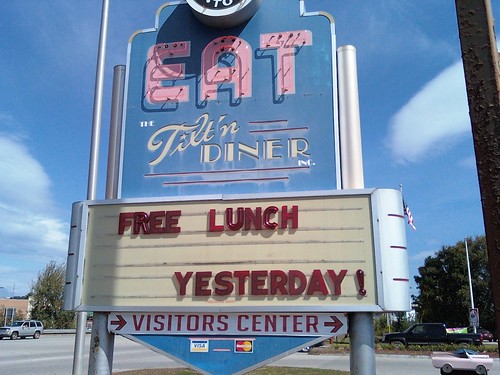
In the first five minutes of my first economics class in high school, my teacher defined the study of economics using another popular phrase: “There’s no such thing as a free lunch.”
Economically speaking, this means that everything always has a cost. What is free to you comes at a cost to someone else. There are fixed resources. Life is a closed system. There are so many hours in a day and so many days in a week; the cost of choosing to do one thing is not choosing to use that time to do something else. There are only so many dollars in your bank account; the cost of choosing to purchase one thing is the choice not to purchase that other thing.
Everything has a cost, and the true cost of something is what else you give up to get it. And I dare say that there are plenty of things in our lives – from coaches and teachers to bosses and television commercials, from our families to our own ambitions – that continually promise us the world, if only we give up our lives to get it.
Jesus, too, knows the demands that are placed on our lives. This is why he asks the pointed question in today’s gospel, “for what will it profit [you] to gain the whole world and forfeit [your] life?
This question exposes the temptation we all face: to forfeit our lives in order to gain the whole world; to give give give all of our time and money and energy for some promised future reward, which we hope will be, at best, equal in value to what we gave up to get it.
And so Jesus’ question for each of us is this: what are you losing your life for, either by choice or circumstance?
As a person with a career, are you losing your life to the demands of your company and your clients so that you will be considered successful?
As someone who suffers or watches someone suffer from chronic illness, are you losing your life to the intricacies of medical care, or to a sense of fear and despair?
As a spouse or significant other, do you feel pressure to lose yourself to your relationship?
As a student, are you losing your life to your grades or to your fear of failure or to the pressure to achieve a lot now so that you can get into a good college and go forward to live a successful adult life?
As a parent, are you losing your life to all the activities that your children do in the name of personal growth and well-roundedness?
As a soul dealing with anxiety or depression, are you losing your life to the masks you put up to convince the world that everything is fine?
As a broken and flawed human being – as we all are – are you losing your life to shame, fear, or regret?
And when you lose your life to any of these things, do you find yourself feeling renewed or fulfilled? I suspect not. I suspect that giving up your life for these things leaves you feeling tired at the end of the week, fragile, anxious, wistful. Because what of these sorts of things are worth what you give up to get them?
But what does Jesus say we should lose our lives for? Jesus says, “whoever loses their life for my sake, and for the sake of the gospel, will save it.”
These words, my brothers and sisters, are words of freedom. Listen to what he is saying. There is only reason that Jesus calls you to lose your life: for his sake. Jesus asks us, as his disciples, to give up ourselves for the sake of the good news that he brings. This means giviving ourselves over to being peacemakers and healers, kind and gentle souls, beacons of hope, voices of praise, signs of compassion, reconcilers and restorers, even as God has reconciled and restored us.
And I know that sounds like a lot. And maybe you’re wondering how much of your current life you’ll have to give up to make space for all of that. Maybe you’re terrified to give up the life and lifestyle you have for the sake of those things, because you know that once you do, there’s no going back.
But hear again the words of promise that Jesus gives you: “Whoever loses their life for my sake and for the sake of the gospel will save it.” Jesus has already given up his whole life for you and for the sake of the world. He has turned the world upside down to reveal a kingdom of God where we are saved by grace and not by works. He has defeated death and won for us abundant life. And so he is the only one that truly gets to demand your life. And to what end? In order that you might receive a new life in return, a new heart and a new spirit, the fullness of God’s grace and mercy flowing through you.
The good news is that Jesus defies economic theory. Faith and discipleship are not a zero-sum game. God’s grace and mercy do not exist in finite quantities. At the Lord’s table, there is such a thing as a free lunch of grace and forgiveness. The cost of giving up your life for the sake of the gospel is outweighed by the irrational truth that you will get back more than you gave. Giving over your life for the sake of Jesus will get you back more life than you started with. More hope, more grace, more peace, more joy, more freedom.
Friends, you are free to say “no” to all other things in your world that demand your whole life. You are free to talk back to the voices that try to tell you that if you don’t try to do it all, you won’t be successful. You are free to find your worth not in what you do, but in who you are: a beloved child of God.
And so Jesus asks you, and asks me, and asks all of us: “What will it profit you to gain the whole world and forfeit your life?”
“But,” he says, “if you give your life to me, and lose your life to God’s good news, then I promise that you will have life and have it abundantly.”
May God give us the strength and wisdom to seek this life always.
7.30.2012
Things I love
If you were to take a serious look at my online presence - Facebook, Twitter, Blogger - you would find that I am a horribly predictable person. Every Friday (my day off), there is a greater than 90% chance that I tweet or put up a FB status about what I plan to do with my day. Or a summary tweet in the afternoon talking about what I had already accomplished. Same goes for Saturdays when I have them free.
And that list of activities will always include at least two of the following: knitting, going to the Arboretum, going out for coffee, watching baseball, going to the farmer's market, or cooking/baking
If you were to expand out a bit and look at my day-to-day tweets and status updates, you'd find that more than half of them have to do with coffee (or tea), Bach, reading, writing, and eating.
I am one predictable and easy-to-figure out lady.
But here's the thing. I know what I like. And I know what feeds my soul. And I know what brings me balance.
Reading/writing: An old favorite. I love words. I love finding perfect words to describe what I'm seeing, thinking, or feeling. I love seeing how other people use words. This is probably also why I love writing sermons...
Knitting: It is the only form of visual art that I am good at. I am fascinated by color, I love touching soft things, I like that I can make something beautiful with my own two hands, and I am fascinated by the way that projects take shape. Bonus: I knit to knit, which leaves me with leftover projects without homes, which is GREAT for gift-giving.
Coffee: I blame my genetics for my love of coffee (the substance). I blame a particular group of high school friends for my love of coffee shops. Coffee is delicious, and going out for coffee is a change of pace and a change of scenery. So I use my coffee outings purposefully. I'm also very productive at coffee shops, so much sermon-writing happens there.
Cooking/baking/FOOD: I love eating. And if I love eating good food, then it follows that I love trying my best to MAKE good food. Part of it is the proud, creative, "I made this" feeling that also applies to knitting. And food is how my family celebrates and reunites. So cooking is about food and about sharing.
J.S. Bach: My favorite composer, hands-down. Fun to sing, fun to play, great to listen to. And something about Bach's music strikes me as profoundly ordered...and profoundly creative within that order. So it's definitely balance-restoring for me.
Morton Arboretum: A place I went to as a child, and now a place that is right up the road from where we live. Trees. Flowers. Hiking paths. Lots of land, so that even on crowded days, I can walk and hike and be all by myself. A great place to wander, or to bike, or to have a picnic. A fantastic place to bring my camera and pretend I'm a great nature photographer. And a great place to sit outside for a while, since we don't have a house with a lawn or anything right now.
So anyway, now you know a little more about my favorite things. I don't mind that I do nearly the same thing every weekend. And I don't mind that I tweet about it, even if there's nothing new under the sun to say about it.
How about you? What are the things that you come back to, over and over again, that bring you joy and peace and balance?
And that list of activities will always include at least two of the following: knitting, going to the Arboretum, going out for coffee, watching baseball, going to the farmer's market, or cooking/baking
If you were to expand out a bit and look at my day-to-day tweets and status updates, you'd find that more than half of them have to do with coffee (or tea), Bach, reading, writing, and eating.
I am one predictable and easy-to-figure out lady.
But here's the thing. I know what I like. And I know what feeds my soul. And I know what brings me balance.
Reading/writing: An old favorite. I love words. I love finding perfect words to describe what I'm seeing, thinking, or feeling. I love seeing how other people use words. This is probably also why I love writing sermons...
Knitting: It is the only form of visual art that I am good at. I am fascinated by color, I love touching soft things, I like that I can make something beautiful with my own two hands, and I am fascinated by the way that projects take shape. Bonus: I knit to knit, which leaves me with leftover projects without homes, which is GREAT for gift-giving.
Coffee: I blame my genetics for my love of coffee (the substance). I blame a particular group of high school friends for my love of coffee shops. Coffee is delicious, and going out for coffee is a change of pace and a change of scenery. So I use my coffee outings purposefully. I'm also very productive at coffee shops, so much sermon-writing happens there.
Cooking/baking/FOOD: I love eating. And if I love eating good food, then it follows that I love trying my best to MAKE good food. Part of it is the proud, creative, "I made this" feeling that also applies to knitting. And food is how my family celebrates and reunites. So cooking is about food and about sharing.
J.S. Bach: My favorite composer, hands-down. Fun to sing, fun to play, great to listen to. And something about Bach's music strikes me as profoundly ordered...and profoundly creative within that order. So it's definitely balance-restoring for me.
Morton Arboretum: A place I went to as a child, and now a place that is right up the road from where we live. Trees. Flowers. Hiking paths. Lots of land, so that even on crowded days, I can walk and hike and be all by myself. A great place to wander, or to bike, or to have a picnic. A fantastic place to bring my camera and pretend I'm a great nature photographer. And a great place to sit outside for a while, since we don't have a house with a lawn or anything right now.
So anyway, now you know a little more about my favorite things. I don't mind that I do nearly the same thing every weekend. And I don't mind that I tweet about it, even if there's nothing new under the sun to say about it.
How about you? What are the things that you come back to, over and over again, that bring you joy and peace and balance?
7.08.2012
Pentecost +6: Take nothing for the journey
Jesus left that place and came to his hometown, and his disciples followed him. On the sabbath he began to teach in the synagogue, and many who heard him were astounded. They said, "Where did this man get all this? What is this wisdom that has been given to him? What deeds of power are being done by his hands! Is not this the carpenter, the son of Mary and brother of James and Joses and Judas and Simon, and are not his sisters here with us?" And they took offense at him. Then Jesus said to them, "Prophets are not without honor, except in their hometown, and among their own kin, and in their own house." And he could do no deed of power there, except that he laid his hands on a few sick people and cured them. And he was amazed at their unbelief.
Then he went about among the villages teaching. He called the twelve and began to send them out two by two, and gave them authority over the unclean spirits. He ordered them to take nothing for their journey except a staff; no bread, no bag, no money in their belts; but to wear sandals and not to put on two tunics. He said to them, "Wherever you enter a house, stay there until you leave the place. If any place will not welcome you and they refuse to hear you, as you leave, shake off the dust that is on your feet as a testimony against them." So they went out and proclaimed that all should repent. They cast out many demons, and anointed with oil many who were sick and cured them. (Mark 6:1-13)
---
July’s edition of “Real Simple” magazine contains recipes for some great summer drinks, a page full of ideas for wacky hot dog toppings, and reviews for both lip balm and patio furniture alike.
It also contains a five-page spread teaching you how to “pack like a pro” for your summer travels. A psychologist gives you advice for how to eliminate packing anxiety. Fashion editors weigh in on how to pick a handful of clothing items that can be mixed and matched for maximum style but minimum suitcase space. Travel advisors offer you folding instructions for a variety of garments, as well two strategies for wrinkle-free folding and packing. And organizational consultants give you a packing “roadmap,” showing you how to fit everything nicely and efficiently inside your suitcase.
Too bad I read this article in the airport on my way HOME from two back-to-back weeks of traveling…
For both of my week-long trips, I fooled myself into thinking that I was packing light…even though I packed twice as many shirts as I needed for each week, and two swimsuits instead of one, just in case, and all of my portable electronics and chargers. And if we’re going to be honest here, it’s absurd how proud of myself I felt when I decided NOT to pack a hairdryer for either trip, as if that one appliance were really the dividing line between packing and over-packing.
And so it’s hard not to be haunted by Jesus’ words in today’s gospel: “take nothing for your journey except a staff; no bread, no bag, no money in your belts; wear sandals but do not put on two tunics.”
Let me tell you, that sort of talk doesn’t sell many magazines. Usually we pack with an eye on being prepared for any situation. Jesus turns that thinking upside-down. The message in today’s gospel isn’t about being prepared. It’s about being vulnerable.
Now the hometown crowd that Jesus hangs out with in the first half of today’s gospel? They are definitely NOT vulnerable. They are defiant, full of themselves, scoffing at the return of Jesus, the hometown hero. They resist. We read that Jesus was “amazed at their unbelief.” And so when Jesus tries to do any deeds of power? Nothing. Nada. He can’t. Their invulnerable hard hearts get in the way of Jesus being able to do his work.
On the other hand, Jesus sends the disciples out as vulnerable as they can be. “Take nothing,” he says. “Leave everything behind for the sake of the gospel, rely on the hospitality of others, and travel without any security blankets so that your faith and their witness can shine through, clear as day.”
So I think that we are meant to identify with both the hometown crowd and with the disciples in today’s gospel. One group is afraid to be vulnerable, the other is forced to be. And they both teach us that all the stuff – material and immaterial – that we collect as a thick skin around us is the very stuff that impedes our ability to let God work in us and in the world.
Like that hometown crowd, we sometimes collect up anger, skepticism, stubbornness, and a desire for self-determination, and we pad ourselves in with these thoughts and feelings to keep God from getting too close or to keep God from sending us off to vulnerable places for the sake of the gospel.
And then there are the disciples. I have to imagine that Jesus gave them such direct packing because they, just like us, really wanted to pack that extra “just-in-case” suitcase. And we have lots of “just-in-case” suitcases lying around our lives, right? Your “just-in-case” suitcase might look like a resume-building project that you take on at work, or it might look like your super-deluxe-premium TV/wireless/phone/internet package. It might look like that pair of jeans you bought that you didn’t really need, but they were cheap and they fit, or the phone and computer you upgraded to keep up with the latest technology.
And so we collect all of these emotions and belongings, often without thinking about it, because our hearts know on some level that we can use all of this stuff as a shield that will minimize our vulnerability and our reliance on God and on one another. We use abundance and self-reliance as both buffer and crutch. Because it’s the message we hear all the time: More is better. You can have it all if you just want it enough. Thick skin is a sign of strength. Abundance is a sign of success.
Writer and pastor Mihee Kim-Kort describes how she tries to resist those "you should have it all" messages:
In Luther’s Small Catechism, he talks about how when we pray “Thy kingdom come,” it’s not that we, through our praying, somehow make that kingdom happen. God’s kingdom coming isn’t dependent upon our praying for it to make it happen, because God can do what God will. But we pray for it anyway, and pray that it would come to us. I think there’s a corollary here. We don’t do anything to make God’s kingdom come or to make God act in the world – God can do that all on his own. But we can stand in the way of God’s work. And so this is why we need to let go of the baggage that gets in the way of our witness and God’s action.
Now is this easy? Not at all. Jesus tells the disciples that there will be people who accept the message of God’s love and people who will refuse to hear them out. There will be people who offer them hospitality and people who won’t.
But Jesus sends us out nonetheless, as living signs of God’s grace and love, stripped of anything that might get in the way of that message. Jesus empowers us to let go for the sake of the gospel.
In practice, “letting go” might feel a little bit like spiritual spring cleaning.
We first have to ask ourselves the question, “Can others see the grace and love of God in the way I’m living?” (I’ll give you a hint – even at our very best, the answer to that question is “needs improvement.”)
And so we have to ask follow up questions: “What stuff do I need to get rid of, what items in my schedule need paring down, what ambitions do I need to rethink, and what patterns of spending my time and money do I need to change in order for God’s hopes and dreams to be apparent to others around me?” And, “What emotions, biases, and hardness of heart do I need to acknowledge and clear away so that God can move freely in and through me?”
And these are questions we have to ask ourselves each and every day. Because a life of faith is a life of conversion – a daily turning and returning to grace, an ongoing process of reorienting ourselves to God’s grace, continually returning to the foot of the cross and revisiting the empty tomb where we remember that God brings strength from weakness, life from death, power from vulnerability, and hope from chaos.
And it’s also about coming back here, week after week, to splash in the water of our baptisms, and to eat the bread and wine that draw us into Christ’s body, so that we can find the strength to get over the idea that we can or should do it all ourselves, and instead go out to pursue lives of just getting the heck out of the way, so that God’s spirit, which hovered over the waters at creation, can also blow through our lives today, and can have the freedom and space to move.
So when you pack up your kids for camp in these next weeks, or organize your suitcase for your next business trip, or pack up to move off to college or into a new house, pause for a moment, and consider leaving it all behind. Think seriously about what it would look like to take nothing with you for your journey. Think about what it means to be vulnerable and to rely on nothing but God’s mercy.
And then, when realize that you probably DO need some clean underwear for your week away and you turn back to your suitcase, at least think about leaving the hairdryer and gel behind this time. Go for the wind-blown look and trust the breeze to dry your hair. Because you never know - it might just be the wind of the spirit, leading you to new people, new places, and new experiences of an unhindered God moving in you and through you. Don’t you want to be free to see where it leads?
Then he went about among the villages teaching. He called the twelve and began to send them out two by two, and gave them authority over the unclean spirits. He ordered them to take nothing for their journey except a staff; no bread, no bag, no money in their belts; but to wear sandals and not to put on two tunics. He said to them, "Wherever you enter a house, stay there until you leave the place. If any place will not welcome you and they refuse to hear you, as you leave, shake off the dust that is on your feet as a testimony against them." So they went out and proclaimed that all should repent. They cast out many demons, and anointed with oil many who were sick and cured them. (Mark 6:1-13)
---
July’s edition of “Real Simple” magazine contains recipes for some great summer drinks, a page full of ideas for wacky hot dog toppings, and reviews for both lip balm and patio furniture alike.
It also contains a five-page spread teaching you how to “pack like a pro” for your summer travels. A psychologist gives you advice for how to eliminate packing anxiety. Fashion editors weigh in on how to pick a handful of clothing items that can be mixed and matched for maximum style but minimum suitcase space. Travel advisors offer you folding instructions for a variety of garments, as well two strategies for wrinkle-free folding and packing. And organizational consultants give you a packing “roadmap,” showing you how to fit everything nicely and efficiently inside your suitcase.
Too bad I read this article in the airport on my way HOME from two back-to-back weeks of traveling…
For both of my week-long trips, I fooled myself into thinking that I was packing light…even though I packed twice as many shirts as I needed for each week, and two swimsuits instead of one, just in case, and all of my portable electronics and chargers. And if we’re going to be honest here, it’s absurd how proud of myself I felt when I decided NOT to pack a hairdryer for either trip, as if that one appliance were really the dividing line between packing and over-packing.
And so it’s hard not to be haunted by Jesus’ words in today’s gospel: “take nothing for your journey except a staff; no bread, no bag, no money in your belts; wear sandals but do not put on two tunics.”
Let me tell you, that sort of talk doesn’t sell many magazines. Usually we pack with an eye on being prepared for any situation. Jesus turns that thinking upside-down. The message in today’s gospel isn’t about being prepared. It’s about being vulnerable.
Now the hometown crowd that Jesus hangs out with in the first half of today’s gospel? They are definitely NOT vulnerable. They are defiant, full of themselves, scoffing at the return of Jesus, the hometown hero. They resist. We read that Jesus was “amazed at their unbelief.” And so when Jesus tries to do any deeds of power? Nothing. Nada. He can’t. Their invulnerable hard hearts get in the way of Jesus being able to do his work.
On the other hand, Jesus sends the disciples out as vulnerable as they can be. “Take nothing,” he says. “Leave everything behind for the sake of the gospel, rely on the hospitality of others, and travel without any security blankets so that your faith and their witness can shine through, clear as day.”
So I think that we are meant to identify with both the hometown crowd and with the disciples in today’s gospel. One group is afraid to be vulnerable, the other is forced to be. And they both teach us that all the stuff – material and immaterial – that we collect as a thick skin around us is the very stuff that impedes our ability to let God work in us and in the world.
Like that hometown crowd, we sometimes collect up anger, skepticism, stubbornness, and a desire for self-determination, and we pad ourselves in with these thoughts and feelings to keep God from getting too close or to keep God from sending us off to vulnerable places for the sake of the gospel.
And then there are the disciples. I have to imagine that Jesus gave them such direct packing because they, just like us, really wanted to pack that extra “just-in-case” suitcase. And we have lots of “just-in-case” suitcases lying around our lives, right? Your “just-in-case” suitcase might look like a resume-building project that you take on at work, or it might look like your super-deluxe-premium TV/wireless/phone/internet package. It might look like that pair of jeans you bought that you didn’t really need, but they were cheap and they fit, or the phone and computer you upgraded to keep up with the latest technology.
And so we collect all of these emotions and belongings, often without thinking about it, because our hearts know on some level that we can use all of this stuff as a shield that will minimize our vulnerability and our reliance on God and on one another. We use abundance and self-reliance as both buffer and crutch. Because it’s the message we hear all the time: More is better. You can have it all if you just want it enough. Thick skin is a sign of strength. Abundance is a sign of success.
Writer and pastor Mihee Kim-Kort describes how she tries to resist those "you should have it all" messages:
I say to all that which tells me..that I want or need it all: SHUT UP. I’m going to just try to pursue that which I would want to pass on to my children: simplicity, contentment, equality, the TRUTH…that letting go is usually the best way to go about much of life…not only for the heavy and burdensome but even for those things that look pretty.Letting go. These two words sum up the theology of today’s gospel. It’s all about letting go of our resistance and becoming the unequipped (but commissioned!) disciples that Jesus sends out. It’s about letting go of belongings, certainty, and self-reliance – all for the sake of the gospel. It’s about clearing the sight-lines so that we can have a clear view of God in the world and the gospel shining through us.
In Luther’s Small Catechism, he talks about how when we pray “Thy kingdom come,” it’s not that we, through our praying, somehow make that kingdom happen. God’s kingdom coming isn’t dependent upon our praying for it to make it happen, because God can do what God will. But we pray for it anyway, and pray that it would come to us. I think there’s a corollary here. We don’t do anything to make God’s kingdom come or to make God act in the world – God can do that all on his own. But we can stand in the way of God’s work. And so this is why we need to let go of the baggage that gets in the way of our witness and God’s action.
Now is this easy? Not at all. Jesus tells the disciples that there will be people who accept the message of God’s love and people who will refuse to hear them out. There will be people who offer them hospitality and people who won’t.
But Jesus sends us out nonetheless, as living signs of God’s grace and love, stripped of anything that might get in the way of that message. Jesus empowers us to let go for the sake of the gospel.
In practice, “letting go” might feel a little bit like spiritual spring cleaning.
We first have to ask ourselves the question, “Can others see the grace and love of God in the way I’m living?” (I’ll give you a hint – even at our very best, the answer to that question is “needs improvement.”)
And so we have to ask follow up questions: “What stuff do I need to get rid of, what items in my schedule need paring down, what ambitions do I need to rethink, and what patterns of spending my time and money do I need to change in order for God’s hopes and dreams to be apparent to others around me?” And, “What emotions, biases, and hardness of heart do I need to acknowledge and clear away so that God can move freely in and through me?”
And these are questions we have to ask ourselves each and every day. Because a life of faith is a life of conversion – a daily turning and returning to grace, an ongoing process of reorienting ourselves to God’s grace, continually returning to the foot of the cross and revisiting the empty tomb where we remember that God brings strength from weakness, life from death, power from vulnerability, and hope from chaos.
And it’s also about coming back here, week after week, to splash in the water of our baptisms, and to eat the bread and wine that draw us into Christ’s body, so that we can find the strength to get over the idea that we can or should do it all ourselves, and instead go out to pursue lives of just getting the heck out of the way, so that God’s spirit, which hovered over the waters at creation, can also blow through our lives today, and can have the freedom and space to move.
So when you pack up your kids for camp in these next weeks, or organize your suitcase for your next business trip, or pack up to move off to college or into a new house, pause for a moment, and consider leaving it all behind. Think seriously about what it would look like to take nothing with you for your journey. Think about what it means to be vulnerable and to rely on nothing but God’s mercy.
And then, when realize that you probably DO need some clean underwear for your week away and you turn back to your suitcase, at least think about leaving the hairdryer and gel behind this time. Go for the wind-blown look and trust the breeze to dry your hair. Because you never know - it might just be the wind of the spirit, leading you to new people, new places, and new experiences of an unhindered God moving in you and through you. Don’t you want to be free to see where it leads?
2.10.2012
Scarcity to abundance: ELCA World Hunger Leadership Gathering day 2
I am proud to have received my first sunburn of 2012. This happened while I was on an afternoon field trip to the ECHO Global Farm and Research Center here in Fort Myers.
As an organization, ECHO (Educational Concerns for Hunger Organization) is an organization that does hands-on agricultural development and education. It dedicates itself to developing farming techniques and simple innovations, as well as agricultural development and know-how, in order to help communities across the world learn how to farm well in their own specific climates. They prove that anyone – and any community – can do simple things to create abundant and sustainable food sources. It is an amazing way to address hunger in the world, and to help fix the hunger problem rather than just offering relief. It is real change, in garden form.
I had the opportunity to tour the Global Farm and Research Center here in Fort Myers. They literally simulate climates and soil conditions from all over the world, and learn what plants grow, and how to irrigate, and how to adapt farming for best yield. It is a demonstration farm, where staff and interns develop farm plots, play with simple and innovative technologies, and then teach what they discover to mission partners across the world.
I learned many things during my visit.
I learned about how you can take any variety of container, and with a little knowledge, you can grow anything from lettuce to butterfly weed to a starfruit tree.


I learned about this crazy Moringa bush, which is truly a miracle plant. It grows easily and quickly. Its leaves are edible (tasty – sort of like extra-peppery arugula!) and contain a ridiculous number of vitamins and nutrients. You can dry the leaves, which will retain most of the nutrients, and then crush them up to use as a nutritious additive to food and baby formula. Its seeds can be crushed up and – get this – they can purify water! They can remove nearly 95% of bacteria in water, and if you they put the water out in the sun and let UV rays get to it, you can get that water nearly 99% clean!

I learned that you can take common “found items,” in any community, in any country, and build tools, irrigation systems, rain barrels, trellises, stakes, and any other number of agricultural tools.

I learned that you can be smart with how you raise animals so that you can make the most of the circle of life…and, to be honest, how to harness the power of poop. ☺


I learned about how you can use plants as tools and architecture: living fences, deep-rooted plants on hillsides to build tiers and to prevent erosion, taking advantage of acacia trees that shed leaves in the spring and grow shade in the winter under which to grow sun-sensitive plants.

One member of our group talked about the experience in terms of “abundance out of scarcity.” And it’s true. ECHO showed us that you can take the worst of the worst “soil” and to turn it into an overflowing bounty. It taught us that with dedication and ingenuity, you can do simple things to create sustainable gardens and farms in any climate, for any people. All it takes is one seed to create more seeds, and you are off and running. One tree becomes many. And you can feed a village!
As an organization, ECHO (Educational Concerns for Hunger Organization) is an organization that does hands-on agricultural development and education. It dedicates itself to developing farming techniques and simple innovations, as well as agricultural development and know-how, in order to help communities across the world learn how to farm well in their own specific climates. They prove that anyone – and any community – can do simple things to create abundant and sustainable food sources. It is an amazing way to address hunger in the world, and to help fix the hunger problem rather than just offering relief. It is real change, in garden form.
I had the opportunity to tour the Global Farm and Research Center here in Fort Myers. They literally simulate climates and soil conditions from all over the world, and learn what plants grow, and how to irrigate, and how to adapt farming for best yield. It is a demonstration farm, where staff and interns develop farm plots, play with simple and innovative technologies, and then teach what they discover to mission partners across the world.
I learned many things during my visit.
I learned about how you can take any variety of container, and with a little knowledge, you can grow anything from lettuce to butterfly weed to a starfruit tree.


I learned about this crazy Moringa bush, which is truly a miracle plant. It grows easily and quickly. Its leaves are edible (tasty – sort of like extra-peppery arugula!) and contain a ridiculous number of vitamins and nutrients. You can dry the leaves, which will retain most of the nutrients, and then crush them up to use as a nutritious additive to food and baby formula. Its seeds can be crushed up and – get this – they can purify water! They can remove nearly 95% of bacteria in water, and if you they put the water out in the sun and let UV rays get to it, you can get that water nearly 99% clean!

I learned that you can take common “found items,” in any community, in any country, and build tools, irrigation systems, rain barrels, trellises, stakes, and any other number of agricultural tools.

I learned that you can be smart with how you raise animals so that you can make the most of the circle of life…and, to be honest, how to harness the power of poop. ☺


I learned about how you can use plants as tools and architecture: living fences, deep-rooted plants on hillsides to build tiers and to prevent erosion, taking advantage of acacia trees that shed leaves in the spring and grow shade in the winter under which to grow sun-sensitive plants.

One member of our group talked about the experience in terms of “abundance out of scarcity.” And it’s true. ECHO showed us that you can take the worst of the worst “soil” and to turn it into an overflowing bounty. It taught us that with dedication and ingenuity, you can do simple things to create sustainable gardens and farms in any climate, for any people. All it takes is one seed to create more seeds, and you are off and running. One tree becomes many. And you can feed a village!
11.30.2011
Advent 1: Wednesday
Ian Morgan Cron has written an intriguing blog post titled, "Is Jesus Just Background Music in Your Life?" He wonders out loud about whether there is so much Jesus "background noise" in our lives that we lose hold of the intrigue and mystery of who Jesus really is.
Cron quotes Max Picard’s The World of Silence, in which he writes,
This Advent, what are you going to do to preserve your layer of silence? How are you going to keep enough space between yourself and the noise of Christmas preparations that you can focus on the mystery of God-made flesh?
Cron quotes Max Picard’s The World of Silence, in which he writes,
Today, when there is only noise in and around man, it is difficult to approach the mystery. When the layer of silence is missing, the extraordinary easily becomes connected with the ordinary, with the routine flow of things, and man reduces the extraordinary to a mere part of the mechanical routine.Advent is a time for shutting out the background noise, even background noise about Jesus. Advent is a time for honing in and really listening to the genius in the music, so to speak, of the crazy, improbable, life-giving story of God's divine power breaking through the sky and coming to rest in a manger.
This Advent, what are you going to do to preserve your layer of silence? How are you going to keep enough space between yourself and the noise of Christmas preparations that you can focus on the mystery of God-made flesh?
11.24.2011
Good Gifts (something to think about on Black Friday)
[December was my month to write the "Musings" column for the church newsletter; this is a copy of what I wrote, but this time with a picture and links!]
 Nadia Bolz-Weber is the pastor at House for All Sinners and Saints in Denver, Colorado. HFASS (as they refer to themselves) is an alternative Lutheran congregation in the heart of the city, with a pronounced focus on social justice. A few years ago, HFASS created an art project during Advent which they titled, "Our Lady of the New Advent."
They created an icon, a picture of Mary holding the baby Jesus, out of scraps of Christmas advertising they received in the mail. They did this as a way of faithfully subverting the world’s message that Advent and Christmas are about stuff rather than Spirit.
Nadia says, "Every piece of this [icon] is from Christmas ads: circulars, catalogs and all that junk that comes in the mail and the newspaper. An artist in the community traced the image [of the mother and child] onto poster board indicating what color should go in each shape. People ages six to sixty-five cut out the right color from the ads and glued it in the space. Easy and subversive."
In this Advent season, our challenge as people of faith is to make meaningful choices about where we spend our time, energy, and money against a world that becomes more and more commercial with each passing holiday season. Our faith asks us to appreciate the season’s emphasis on giving, but to make different choices about how we give, and how much we give.
We have a number of alternative giving opportunities here at St. Timothy this year. These are ways that we can choose to give in more meaningful ways and honor the gift of Christ that is given for the sake of the world.
As in past years, we have set up our Christmas Giving Tree table, where you can purchase gifts for foster children through Lutheran Social Services of Illinois, and where you can donate rent money for homeless families supported by Bridge Communities.
New this year is our upcoming fair trade fair, in partnership with Lutheran World Relief and SERRV, to take place December 10/11 and 17/18. Fair trade goods are items produced in developing countries that are distributed for purchase with the goal of emphasizing fair wages, sustainable practices, and direct support for artisans. Stop by the fair trade tables in the narthex during these two weeks in December to purchase ornaments, candles, jewelry, accessories, coffee and chocolate. Purchase gifts for your family and friends, knowing that you are using your money to do good in the world.
Another way to embrace the spirit of giving and to use your money in a meaningful way is to purchase items from the ELCA Good Gifts catalogue. Visit the social ministry table to pick up a copy of the catalogue. Purchase a pig, goat or alpaca on behalf of a family member, and help a family or village across the world secure a reliable source of food and income. Purchase a well, an irrigation canal, or water jugs in honor of a coworker, and help people in remote areas of the world gain access to clean water. Flip through the catalogue and decide whether you want to cover school fees for a young girl in a developing country, or help start a community garden, or give meals at a soup kitchen. This catalogue is full of ways that we can join together to support the creative and life-giving work of our church across the nation and the world.
By making different choices about the gifts we give at Christmastime, we honor the spirit of watching and waiting for Christ, not only during the blue season of Advent, but during the whole of our Christian lives. For Christmas is not merely about gifts, but about one particular gift: the gift of hope born in our hearts and lived out for the sake of the world.
So, part of our call as people of faith during Advent is the call to resist the things in our world that try to make shallow the profound longings and promises of faith for which we wait. Part of living intentionally during Advent means that we see Christmas as the arrival of wholeness and salvation. Then, this season can become for us a time to recognize the needs of our world and to live out the true hope of our faith, the promise of light and life brought to earth by the Christ child in the manger.
Nadia Bolz-Weber is the pastor at House for All Sinners and Saints in Denver, Colorado. HFASS (as they refer to themselves) is an alternative Lutheran congregation in the heart of the city, with a pronounced focus on social justice. A few years ago, HFASS created an art project during Advent which they titled, "Our Lady of the New Advent."They created an icon, a picture of Mary holding the baby Jesus, out of scraps of Christmas advertising they received in the mail. They did this as a way of faithfully subverting the world’s message that Advent and Christmas are about stuff rather than Spirit.
Nadia says, "Every piece of this [icon] is from Christmas ads: circulars, catalogs and all that junk that comes in the mail and the newspaper. An artist in the community traced the image [of the mother and child] onto poster board indicating what color should go in each shape. People ages six to sixty-five cut out the right color from the ads and glued it in the space. Easy and subversive."
In this Advent season, our challenge as people of faith is to make meaningful choices about where we spend our time, energy, and money against a world that becomes more and more commercial with each passing holiday season. Our faith asks us to appreciate the season’s emphasis on giving, but to make different choices about how we give, and how much we give.
We have a number of alternative giving opportunities here at St. Timothy this year. These are ways that we can choose to give in more meaningful ways and honor the gift of Christ that is given for the sake of the world.
As in past years, we have set up our Christmas Giving Tree table, where you can purchase gifts for foster children through Lutheran Social Services of Illinois, and where you can donate rent money for homeless families supported by Bridge Communities.
New this year is our upcoming fair trade fair, in partnership with Lutheran World Relief and SERRV, to take place December 10/11 and 17/18. Fair trade goods are items produced in developing countries that are distributed for purchase with the goal of emphasizing fair wages, sustainable practices, and direct support for artisans. Stop by the fair trade tables in the narthex during these two weeks in December to purchase ornaments, candles, jewelry, accessories, coffee and chocolate. Purchase gifts for your family and friends, knowing that you are using your money to do good in the world.
Another way to embrace the spirit of giving and to use your money in a meaningful way is to purchase items from the ELCA Good Gifts catalogue. Visit the social ministry table to pick up a copy of the catalogue. Purchase a pig, goat or alpaca on behalf of a family member, and help a family or village across the world secure a reliable source of food and income. Purchase a well, an irrigation canal, or water jugs in honor of a coworker, and help people in remote areas of the world gain access to clean water. Flip through the catalogue and decide whether you want to cover school fees for a young girl in a developing country, or help start a community garden, or give meals at a soup kitchen. This catalogue is full of ways that we can join together to support the creative and life-giving work of our church across the nation and the world.
By making different choices about the gifts we give at Christmastime, we honor the spirit of watching and waiting for Christ, not only during the blue season of Advent, but during the whole of our Christian lives. For Christmas is not merely about gifts, but about one particular gift: the gift of hope born in our hearts and lived out for the sake of the world.
So, part of our call as people of faith during Advent is the call to resist the things in our world that try to make shallow the profound longings and promises of faith for which we wait. Part of living intentionally during Advent means that we see Christmas as the arrival of wholeness and salvation. Then, this season can become for us a time to recognize the needs of our world and to live out the true hope of our faith, the promise of light and life brought to earth by the Christ child in the manger.
11.01.2011
Making space?
I need to admit something: I am frustrated today.
I was driving to church, winding my way through the affluence of Chicago suburbs, caught up in the flow of mini-vans and SUVs speeding along around me, catching glimpses of professional landscapers planting thousands of dollars worth of mums and other fall flowers around the base of a grocery store sign at the edge of a strip mall...
And I felt my shoulders stiffen as I thought "This is all too much."
Too much money going to too many unimportant things. Too much speed. Too much being-late-because-we-are-so-overscheduled. Too much ambition...and too much fear.
And when I settled into my office for the day, and read through my emails, and started addressing the questions and needs of families, I thought the same sorts of things: "This is all too much."
How should a church speak to and address the problem of "too much" in a congregation?
How do you address the fear of failure that drives parents to schedule a million college-application-boosting activities for their elementary-aged children?
How do you address the keeping-up-with-the-Jonses panic that keeps people tied to high-income but highly-demanding jobs?
How do you help people get to a place where they feel actually challenged by Jesus' words to the rich young ruler ("sell everything and give it to the poor") or by his words to his disciples when he sent them out to proclaim the kingdom ("Take nothing for your journey, no staff, nor bag, nor bread, nor money — not even an extra tunic")?
Really, how is the church called (or IS it called?) to help empower people to make space in their life so that there is room for God to show up in the still-small voice?
I was driving to church, winding my way through the affluence of Chicago suburbs, caught up in the flow of mini-vans and SUVs speeding along around me, catching glimpses of professional landscapers planting thousands of dollars worth of mums and other fall flowers around the base of a grocery store sign at the edge of a strip mall...
And I felt my shoulders stiffen as I thought "This is all too much."
Too much money going to too many unimportant things. Too much speed. Too much being-late-because-we-are-so-overscheduled. Too much ambition...and too much fear.
And when I settled into my office for the day, and read through my emails, and started addressing the questions and needs of families, I thought the same sorts of things: "This is all too much."
How should a church speak to and address the problem of "too much" in a congregation?
How do you address the fear of failure that drives parents to schedule a million college-application-boosting activities for their elementary-aged children?
How do you address the keeping-up-with-the-Jonses panic that keeps people tied to high-income but highly-demanding jobs?
How do you help people get to a place where they feel actually challenged by Jesus' words to the rich young ruler ("sell everything and give it to the poor") or by his words to his disciples when he sent them out to proclaim the kingdom ("Take nothing for your journey, no staff, nor bag, nor bread, nor money — not even an extra tunic")?
Really, how is the church called (or IS it called?) to help empower people to make space in their life so that there is room for God to show up in the still-small voice?
In the spiritual life, the word ‘discipline’ means ‘the effort to create some space in which God can act.’ Discipline means to prevent everything in your life from being filled up. Discipline means that somewhere you’re not occupied, and certainly not preoccupied. In the spiritual life, discipline means to create that space in which something can happen that you hadn’t planned or counted on. (Henri Nouwen)How is God calling me to make space in my own life? And how is God using me to help encourage others to do so?
10.26.2011
The unoriginal but amazing life
I bought a notebook this morning.
More specifically, a black, softcover Moleskine 2012 Weekly Notebook Diary/Planner. Because in church work, you need to have a January calendar at the ready by the time November hits.
It is my first Moleskine, and kudos to them for having created a brand that carries with it such a particular mystique that it actually seems like an important detail in my life to say "it is my first Moleskine," as if that really means something.
A little baffled and enticed by the sheets of icon stickers in the back pocket, I ventured to the web to see how others had used these stickers...and found no useful pictures or suggestions (not that there is a right or wrong way to use them, but I was curious). But I did end up pouring over blog posts about the creative ways that people use or modify their Moleskines, extensive discussion of the best Moleskine pen (turns out it is the very pen that I am already using!), and glimpses of fascinating people who read many books or drink many wines or travel many places, and then have the patience and inspiration to write about those experiences.
I don't read enough books these days to warrant a book journal, and I would probably have no patience to keep up with it anyway. I don't drink nearly enough wine, nor do I care deeply enough about it, to have any interest in keeping a wine journal (and for as much as I love food and cooking, I'm not sure that a restaurant or food journal would be exactly the right thing for me either).
But travel? I don't do much of it, but I would love to do more. I feel the pull of city-based Moleskines, that include public transportation maps and give you space to write about all the things in a city that you've seen, done, tasted, and experienced.
Or how about a plain old ruled notebook...that could accompany me on travels all across the world? I kept a serious journal during our Tanzania travels. I wrote down all the details I could remember about our days, as well as keeping lists of the food we ate, the animals we saw, and the Swahili we learned. I used that notebook to keep score as we played cards on our flights, I pressed flowers in between its pages, and I saved beer bottle labels in its back pocket.
And so, at this moment, as I stare outside at the gray Chicago sky, I find myself desiring the unoriginal but amazing lives of so many of my fellow young adults: lives filled with travels and journals, laptops and good coffee, a spirit of both exploration and appreciation.
And all because I needed to buy a day planner.
More specifically, a black, softcover Moleskine 2012 Weekly Notebook Diary/Planner. Because in church work, you need to have a January calendar at the ready by the time November hits.
It is my first Moleskine, and kudos to them for having created a brand that carries with it such a particular mystique that it actually seems like an important detail in my life to say "it is my first Moleskine," as if that really means something.
A little baffled and enticed by the sheets of icon stickers in the back pocket, I ventured to the web to see how others had used these stickers...and found no useful pictures or suggestions (not that there is a right or wrong way to use them, but I was curious). But I did end up pouring over blog posts about the creative ways that people use or modify their Moleskines, extensive discussion of the best Moleskine pen (turns out it is the very pen that I am already using!), and glimpses of fascinating people who read many books or drink many wines or travel many places, and then have the patience and inspiration to write about those experiences.
I don't read enough books these days to warrant a book journal, and I would probably have no patience to keep up with it anyway. I don't drink nearly enough wine, nor do I care deeply enough about it, to have any interest in keeping a wine journal (and for as much as I love food and cooking, I'm not sure that a restaurant or food journal would be exactly the right thing for me either).
But travel? I don't do much of it, but I would love to do more. I feel the pull of city-based Moleskines, that include public transportation maps and give you space to write about all the things in a city that you've seen, done, tasted, and experienced.
Or how about a plain old ruled notebook...that could accompany me on travels all across the world? I kept a serious journal during our Tanzania travels. I wrote down all the details I could remember about our days, as well as keeping lists of the food we ate, the animals we saw, and the Swahili we learned. I used that notebook to keep score as we played cards on our flights, I pressed flowers in between its pages, and I saved beer bottle labels in its back pocket.
And so, at this moment, as I stare outside at the gray Chicago sky, I find myself desiring the unoriginal but amazing lives of so many of my fellow young adults: lives filled with travels and journals, laptops and good coffee, a spirit of both exploration and appreciation.
And all because I needed to buy a day planner.
8.24.2011
Kitty litter and dirty coffee cups
My morning happened in themes.
I woke up this morning, already feeling gross and sweaty from the impending 92-degree forecast for today. I pulled myself out of bed, turned on our ceiling fans, and pressed the "on" button to our living room window air conditioning unit. (Which sent the cat scurrying away. She's not much one for noises.) Our apartment is small, but even with two window air conditioning units, it's anybody's guess if we'll come home to a cool apartment or not later tonight.
So the dreaded thought came to me: I'd better clean out Emme's litter box and finish the dishes before I left for church, because a small apartment plus a 92-degree day equals lots of stinkiness if we don't stay on top of the smellier parts of things. (Ahhh...aren't you glad for these rousing insights on my life?)
So I reloaded the dishwasher and finished washing the pots and pans. I scrubbed the countertops (hey, I was on a roll!), emptied the trash, and even remembered to move our fruit bowl off of the kitchen table (and out of the blazing line of sunlight). Then into the study, giving our crazy cat a new fresh litter box and hauling a smelly trash bag to the front door.
Cleaning the apartment, even in these minor ways made me feel good. It will be nice to come home to it tonight. But let me be very clear about something: NOTHING about either of those cleaning tasks made me think of church, of God, or of anything remotely spiritual.
I arrived at church, grumbling as I walked in about how it was 10:00 a.m. and already so warm and humid that my car had trouble picking up its usual radio stations.
When I got to my office, I grabbed my water bottle and headed to the kitchen to fill it up. I decided, on a wise whim, to bring along the old coffee cups that were still lingering on the table behind my desk, with coffee-stained rings around the insides. I scooped them all up and headed to the church kitchen where, for the second time this morning, I found myself scrubbing dishes. After they were all clean, and I had filled up both my water bottle and one mug of coffee, I headed into the sanctuary.
Last night, we offered a Taizé healing service here at St. Timothy, and pulled out lots of candles and icons to illumine the worship space. Part of our worship involved people lighting candles as prayers and placing them in pots of sand as a light and life-giving symbol of prayers rising up to God.
I decided it would be a good idea to start putting away all of the items we had used for worship last night. I got to the pots of sand, which was really not sand at all but gravel, and not unlike the kitty litter I encountered earlier in the morning.
As I finished cleaning up, and grabbed my water bottle and coffee cup to head back to my office, I thought about how my morning had been strangely thematic, centered around kitty litter and dirty dishes.
Remember how I said that my morning tasks at home in no way reminded me of spiritual things? That was a true statement. But the church tasks I did as I started another day of living out my calling to the ministry? The completely reminded me of home things.
And so I wonder if we sometimes get it backwards. Often, we focus on how the life of faith means finding the spiritual embodied in the mundane. And this isn't a bad thing. Certainly the life of faith is a life of reverence, where we are asked, again and again, to see God in our neighbor, in creation, in both the glamorous and smelly parts of our lives.
But what if there is yet something to the notion that the life of faith really means finding the mundane in the spiritual? What if we stopped trying to expect our daily lives to mirror what happens in worship, and what if we instead remembered that everything we do as a people of faith has its roots in the ordinary-ness of human life?
Today, church reminded me of my daily life, and it caused me to stop and think about the way that God chose to mingle both holy and mundane in the embodied Word, that is, the person of Jesus. And how would my life be different if I saw in Jesus the mundane reflected in the spiritual - the human reflected in the divine - rather than the other way around?
I woke up this morning, already feeling gross and sweaty from the impending 92-degree forecast for today. I pulled myself out of bed, turned on our ceiling fans, and pressed the "on" button to our living room window air conditioning unit. (Which sent the cat scurrying away. She's not much one for noises.) Our apartment is small, but even with two window air conditioning units, it's anybody's guess if we'll come home to a cool apartment or not later tonight.
So the dreaded thought came to me: I'd better clean out Emme's litter box and finish the dishes before I left for church, because a small apartment plus a 92-degree day equals lots of stinkiness if we don't stay on top of the smellier parts of things. (Ahhh...aren't you glad for these rousing insights on my life?)
So I reloaded the dishwasher and finished washing the pots and pans. I scrubbed the countertops (hey, I was on a roll!), emptied the trash, and even remembered to move our fruit bowl off of the kitchen table (and out of the blazing line of sunlight). Then into the study, giving our crazy cat a new fresh litter box and hauling a smelly trash bag to the front door.
Cleaning the apartment, even in these minor ways made me feel good. It will be nice to come home to it tonight. But let me be very clear about something: NOTHING about either of those cleaning tasks made me think of church, of God, or of anything remotely spiritual.
I arrived at church, grumbling as I walked in about how it was 10:00 a.m. and already so warm and humid that my car had trouble picking up its usual radio stations.
When I got to my office, I grabbed my water bottle and headed to the kitchen to fill it up. I decided, on a wise whim, to bring along the old coffee cups that were still lingering on the table behind my desk, with coffee-stained rings around the insides. I scooped them all up and headed to the church kitchen where, for the second time this morning, I found myself scrubbing dishes. After they were all clean, and I had filled up both my water bottle and one mug of coffee, I headed into the sanctuary.
Last night, we offered a Taizé healing service here at St. Timothy, and pulled out lots of candles and icons to illumine the worship space. Part of our worship involved people lighting candles as prayers and placing them in pots of sand as a light and life-giving symbol of prayers rising up to God.
I decided it would be a good idea to start putting away all of the items we had used for worship last night. I got to the pots of sand, which was really not sand at all but gravel, and not unlike the kitty litter I encountered earlier in the morning.
As I finished cleaning up, and grabbed my water bottle and coffee cup to head back to my office, I thought about how my morning had been strangely thematic, centered around kitty litter and dirty dishes.
Remember how I said that my morning tasks at home in no way reminded me of spiritual things? That was a true statement. But the church tasks I did as I started another day of living out my calling to the ministry? The completely reminded me of home things.
And so I wonder if we sometimes get it backwards. Often, we focus on how the life of faith means finding the spiritual embodied in the mundane. And this isn't a bad thing. Certainly the life of faith is a life of reverence, where we are asked, again and again, to see God in our neighbor, in creation, in both the glamorous and smelly parts of our lives.
But what if there is yet something to the notion that the life of faith really means finding the mundane in the spiritual? What if we stopped trying to expect our daily lives to mirror what happens in worship, and what if we instead remembered that everything we do as a people of faith has its roots in the ordinary-ness of human life?
Today, church reminded me of my daily life, and it caused me to stop and think about the way that God chose to mingle both holy and mundane in the embodied Word, that is, the person of Jesus. And how would my life be different if I saw in Jesus the mundane reflected in the spiritual - the human reflected in the divine - rather than the other way around?
4.28.2011
Strange beauty

Have you ever had one of those moments where you just get the feeling that something has been set in motion? Where you can't quite put your finger on it, but it feels like the wind is blowing, and not just the wind of spring weather, but the unexpected rush of the Spirit (the ruach, if you will)? From the time I awoke to the time I stepped into the office today, my morning was filled with strange things, beautiful things, and even strangely beautiful things.
My day began in the flat-out strange category. I woke up remembering strange dreams and strange half-awake thoughts that had happened to me overnight. But even stranger than that was the fact that I awoke with "Yatta" stuck in my head. Seriously, if you take the risk of following this link and watching the video,you will understand just how STRANGE it was to have this rattling around in my head. It's a relic from college, when some great and hilarious guys would send out a "Wednesday Nonesense" email each week, with a link to something strange, silly, or bizarrely humorous. Yatta was one of these. Waking up with it stuck in my head was weird and silly, but also a nice reminder of old friends, and a nice catalyst for nostalgia about people, places and memories from many years ago. Yatta is strange...but it definitely put me in a good mood.
As I was driving along Chicago Avenue today, entering the residential corridor of historic houses leading up to North Central College and downtown Naperville, the weather was having an internal conflict. It could not decide whether to be sunny or cloudy. Ahead of me, to the west, storm clouds filled the sky, corner to corner. All was deep gray facing forward.
But behind me, the sun was shining, and shining brightly. The sides of the street were lined with yellow flowering trees that have sprung into bloom with all of the rain we've had recently. These yellow flowers caught the sunlight and glowed up against the background of dark gray clouds, pulling out the blue and green undertones in the sky. The stormy/glowing contrast was spectacular. It was a strange combination of sun and storm, light and shadow, brightness and dark. And in all of its strangeness, it was the most beautiful thing I've seen in a long while.
By the time I wound my way through downtown Naperville, the wind had set the sky in motion, and the odd combination of sun and clouds had dissolved into a cold, flat, overcast sky. But even without the glow of the sun, I noticed that the rainy weeks had set all of downtown into bloom. The trees that all winter had been budding with white Christmas lights were now budding with white and pink and yellow flowers. Even if it doesn't feel like spring, even if the sun has been shy, even if the rain has been a cold rain rather than a warm one, the trees betray the fact that spring is indeed here.
Not only the trees, but the tulips that were planted along the river and throughout the Riverwalk. I hadn't noticed until today that they had been planted. A foil for the dreary day, they were bright and colorful, full of life and hope and joy.
As I looked around a world in bloom, a world thriving and being nurtured by the rain-filled sky, and as I drove, feeling the wind pull my car back and forth, hearing that stupid Yatta song running on repeat in my brain...
...I think I heard a still-small voice.
It said, "things are on the move."
It wasn't an ominous voice. It wasn't a happy-go-lucky voice. It was a serious voice, full of hope. It was a voice that felt neither optimistic nor pessimistic...it just felt true.
I have no idea what these "things" are that are on the move. I feel a little silly for even talking like this, as if I'm claiming any powers of premonition or providence. But there was no doubt in my heart that there was something stirring.
On this morning of strange beauty, I look forward to whatever strange beauty lies ahead, being carried along on the wind of the spirit.
12.10.2010
Keeping Advent, day ten
Something is different this year.
I have not yet put up any Christmas decorations. I have not brought the manger scene up from the garage, nor have I even yet gotten around to hanging the Advent calendar. I have brainstormed gift ideas but not yet made a single purchase, and I have been content to work for long stretches in my office in silence, rather than filling each available second with the Christmas music I love so much.
But I think about Advent all the time. I think about Advent when I look outside at the first snow that is now beginning to melt under the bright winter sun. I think about Advent when I come to this space to write and share. I think about Advent when I spend time with my family and when I seek out sabbath places during this otherwise busy season.
And do you know what the best thing about all of this is? I don't feel anxious about getting Christmas preparations done. I don't feel anxious about the fact that Christmas Eve is in two weeks. I feel content, quiet, unhurried. I feel as if I am truly celebrating the season of Advent and everything it means. My heart - lazy, rebellious, or content as it may be - is whispering to me, "let Christmas happen when it arrives; no sense in being anxious."
For some reason, the following poem seemed to speak directly and beautifully to this truly Advent mood that I'm in these days. Enjoy!
"Making the House Ready for the Lord" by Mary Oliver
Dear Lord, I have swept and I have washed but
Still nothing is as shining as it should be
for you. Under the sink, for example, is an
uproar of mice—it is the season of their
many children. What shall I do? And under the eaves
and through the walls the squirrels
have gnawed their ragged entrances—but it is the season
when they need shelter, so what shall I do? And
the raccoon limps into the kitchen and opens the cupboard
while the dog snores, the cat hugs the pillow;
what shall I do? Beautiful is the new snow falling
in the yard and the fox who is staring boldly
up the path, to the door. And still I believe you will
come, Lord: you will, when I speak to the fox
the sparrow, the lost dog, the shivering sea-goose, know
that really I am speaking to you whenever I say,
as I do all morning and afternoon: Come in, Come in.
I have not yet put up any Christmas decorations. I have not brought the manger scene up from the garage, nor have I even yet gotten around to hanging the Advent calendar. I have brainstormed gift ideas but not yet made a single purchase, and I have been content to work for long stretches in my office in silence, rather than filling each available second with the Christmas music I love so much.
But I think about Advent all the time. I think about Advent when I look outside at the first snow that is now beginning to melt under the bright winter sun. I think about Advent when I come to this space to write and share. I think about Advent when I spend time with my family and when I seek out sabbath places during this otherwise busy season.
And do you know what the best thing about all of this is? I don't feel anxious about getting Christmas preparations done. I don't feel anxious about the fact that Christmas Eve is in two weeks. I feel content, quiet, unhurried. I feel as if I am truly celebrating the season of Advent and everything it means. My heart - lazy, rebellious, or content as it may be - is whispering to me, "let Christmas happen when it arrives; no sense in being anxious."
For some reason, the following poem seemed to speak directly and beautifully to this truly Advent mood that I'm in these days. Enjoy!
"Making the House Ready for the Lord" by Mary Oliver
Dear Lord, I have swept and I have washed but
Still nothing is as shining as it should be
for you. Under the sink, for example, is an
uproar of mice—it is the season of their
many children. What shall I do? And under the eaves
and through the walls the squirrels
have gnawed their ragged entrances—but it is the season
when they need shelter, so what shall I do? And
the raccoon limps into the kitchen and opens the cupboard
while the dog snores, the cat hugs the pillow;
what shall I do? Beautiful is the new snow falling
in the yard and the fox who is staring boldly
up the path, to the door. And still I believe you will
come, Lord: you will, when I speak to the fox
the sparrow, the lost dog, the shivering sea-goose, know
that really I am speaking to you whenever I say,
as I do all morning and afternoon: Come in, Come in.
12.09.2010
Keeping Advent, day nine
 |
| "Patience" by Melanie Weidner |
This painting is based on a quote from the Tao Te Ching: "Do you have the patience to wait until your mud settles and the water is clear? Can you remain unmoving until the right action arises by itself?"
Part of the discipline - and frankly, part of the wonder - of Advent is the patience to which it calls us. This is a season of taking time and space to reflect upon all of our longings and to grow in faith through the practice of waiting. We count down days until Christmas, yes, but the whole Christian life is a life of Advent. We spend our lifetimes awaiting the day when Christ will come again, and with him, the new heavens and new earth that have been promised to us by God.
Yesterday, thanks to a friend, I read a poignant blog post entitled, "Eating Batter." In it, the author says,
We live in a society dominated by instant gratification. Some attempts at the instant are trivial: instant soup, coffee, oatmeal–even Mac’n'Cheese. There’s instant messaging, text messages, twitter and cell phones to help us instantly get in touch. There are unfortunate expressions of our desire for instant gratification: abundant pornography, excessive debt and various addictions to name a few.I would encourage you to follow the above link and read the whole post, and then take the time to consider what life would look like if we shifted our values from "instant" to "eternal." The author likens the difference between these values to the difference between eating cake batter and waiting the requisite time to eat the (better!) cake.
In a society of instant gratification, advent is a time that we embrace the awkward (anyone ever notice how awkwardly awkward is spelled?), choose the silence and worry–worry that things won’t come out right, that we’ve screwed something up. Advent is a time to worry. It is a time to wait. It is a time that is meant to make people worry–especially the powers that be! It is also a time to hope–a time to look forward to what might be. It is a time to build up expectations and make room for something new. Advent isn’t about instant. It’s about waiting.
If we fill our days eating the cake batter of this world, then we are apt to spend lives filled but not fulfilled, satiated but not nourished. This is the challenge to us, my friends, both in Advent and in the wider advent of our lives: to willingly live in a state of longing for the food that does not perish, the food that is for eternal life.
Subscribe to:
Posts (Atom)