It's time again for my annual spiritual practice of blogging each day of Advent; not often my own words, but the words and poems and music and artwork and thoughts of others. Advent is a nice time to collect beautiful things, and I've been doing this for a few years running now. This year, though, I'm doing all of my Advent blogging over at my other blog, "Keeping the Season," where I've tried to collect said artwork/poetry/etc. throughout the year, reflecting on the seasons of the church. This blog actually grew out of my Advent practice. So if you want a daily piece of Advent-related beauty, be sure to check in over there every day from now until Christmas...and beyond! :)

Showing posts with label creative writing. Show all posts
Showing posts with label creative writing. Show all posts
12.03.2012
8.13.2012
Thin Space
Today is
rain after the drought:
Greening the grass,
Slicking the pavement,
Pulling the smell of earth in through the windows,
Overcast overhead.
Today is
Thick air, thin space,
Mists and downpours,
Baptisms for
worried fathers sitting on my couch,
grieving sons and daughters,
men looking for train tickets home,
teenagers saving teenagers,
married couples hanging on by a thread.
Today is Monday.
Today is rain.
Today is thin,
quick to the heart.
rain after the drought:
Greening the grass,
Slicking the pavement,
Pulling the smell of earth in through the windows,
Overcast overhead.
Today is
Thick air, thin space,
Mists and downpours,
Baptisms for
worried fathers sitting on my couch,
grieving sons and daughters,
men looking for train tickets home,
teenagers saving teenagers,
married couples hanging on by a thread.
Today is Monday.
Today is rain.
Today is thin,
quick to the heart.
7.30.2012
Things I love
If you were to take a serious look at my online presence - Facebook, Twitter, Blogger - you would find that I am a horribly predictable person. Every Friday (my day off), there is a greater than 90% chance that I tweet or put up a FB status about what I plan to do with my day. Or a summary tweet in the afternoon talking about what I had already accomplished. Same goes for Saturdays when I have them free.
And that list of activities will always include at least two of the following: knitting, going to the Arboretum, going out for coffee, watching baseball, going to the farmer's market, or cooking/baking
If you were to expand out a bit and look at my day-to-day tweets and status updates, you'd find that more than half of them have to do with coffee (or tea), Bach, reading, writing, and eating.
I am one predictable and easy-to-figure out lady.
But here's the thing. I know what I like. And I know what feeds my soul. And I know what brings me balance.
Reading/writing: An old favorite. I love words. I love finding perfect words to describe what I'm seeing, thinking, or feeling. I love seeing how other people use words. This is probably also why I love writing sermons...
Knitting: It is the only form of visual art that I am good at. I am fascinated by color, I love touching soft things, I like that I can make something beautiful with my own two hands, and I am fascinated by the way that projects take shape. Bonus: I knit to knit, which leaves me with leftover projects without homes, which is GREAT for gift-giving.
Coffee: I blame my genetics for my love of coffee (the substance). I blame a particular group of high school friends for my love of coffee shops. Coffee is delicious, and going out for coffee is a change of pace and a change of scenery. So I use my coffee outings purposefully. I'm also very productive at coffee shops, so much sermon-writing happens there.
Cooking/baking/FOOD: I love eating. And if I love eating good food, then it follows that I love trying my best to MAKE good food. Part of it is the proud, creative, "I made this" feeling that also applies to knitting. And food is how my family celebrates and reunites. So cooking is about food and about sharing.
J.S. Bach: My favorite composer, hands-down. Fun to sing, fun to play, great to listen to. And something about Bach's music strikes me as profoundly ordered...and profoundly creative within that order. So it's definitely balance-restoring for me.
Morton Arboretum: A place I went to as a child, and now a place that is right up the road from where we live. Trees. Flowers. Hiking paths. Lots of land, so that even on crowded days, I can walk and hike and be all by myself. A great place to wander, or to bike, or to have a picnic. A fantastic place to bring my camera and pretend I'm a great nature photographer. And a great place to sit outside for a while, since we don't have a house with a lawn or anything right now.
So anyway, now you know a little more about my favorite things. I don't mind that I do nearly the same thing every weekend. And I don't mind that I tweet about it, even if there's nothing new under the sun to say about it.
How about you? What are the things that you come back to, over and over again, that bring you joy and peace and balance?
And that list of activities will always include at least two of the following: knitting, going to the Arboretum, going out for coffee, watching baseball, going to the farmer's market, or cooking/baking
If you were to expand out a bit and look at my day-to-day tweets and status updates, you'd find that more than half of them have to do with coffee (or tea), Bach, reading, writing, and eating.
I am one predictable and easy-to-figure out lady.
But here's the thing. I know what I like. And I know what feeds my soul. And I know what brings me balance.
Reading/writing: An old favorite. I love words. I love finding perfect words to describe what I'm seeing, thinking, or feeling. I love seeing how other people use words. This is probably also why I love writing sermons...
Knitting: It is the only form of visual art that I am good at. I am fascinated by color, I love touching soft things, I like that I can make something beautiful with my own two hands, and I am fascinated by the way that projects take shape. Bonus: I knit to knit, which leaves me with leftover projects without homes, which is GREAT for gift-giving.
Coffee: I blame my genetics for my love of coffee (the substance). I blame a particular group of high school friends for my love of coffee shops. Coffee is delicious, and going out for coffee is a change of pace and a change of scenery. So I use my coffee outings purposefully. I'm also very productive at coffee shops, so much sermon-writing happens there.
Cooking/baking/FOOD: I love eating. And if I love eating good food, then it follows that I love trying my best to MAKE good food. Part of it is the proud, creative, "I made this" feeling that also applies to knitting. And food is how my family celebrates and reunites. So cooking is about food and about sharing.
J.S. Bach: My favorite composer, hands-down. Fun to sing, fun to play, great to listen to. And something about Bach's music strikes me as profoundly ordered...and profoundly creative within that order. So it's definitely balance-restoring for me.
Morton Arboretum: A place I went to as a child, and now a place that is right up the road from where we live. Trees. Flowers. Hiking paths. Lots of land, so that even on crowded days, I can walk and hike and be all by myself. A great place to wander, or to bike, or to have a picnic. A fantastic place to bring my camera and pretend I'm a great nature photographer. And a great place to sit outside for a while, since we don't have a house with a lawn or anything right now.
So anyway, now you know a little more about my favorite things. I don't mind that I do nearly the same thing every weekend. And I don't mind that I tweet about it, even if there's nothing new under the sun to say about it.
How about you? What are the things that you come back to, over and over again, that bring you joy and peace and balance?
9.01.2010
Everything Matters
I often visit Amazon.com to inspire my reading habit. Recently, I was browsing reader reviews of one particular book, and an astute reviewer made the following comment: "Welcome to the deep shift that is occurring in what it means to be a Christian. Everything matters." That phrase - "everything matters" - stopped me in my tracks. I realized that the very core of my living faith could be summed up in two words from an Amazon.com reader review: Everything Matters. Capital E, capital M.
This expansive and compact theology urges us, as people of faith, to see God in every part of life, especially in those parts of life that we so often ignore.
Taking seriously an Everything Matters theology could drive you to noticing tiny ants on the sidewalk that you'd never seen before, and it could even drive you to feeling bad for stepping on them! And while that probably sounds extreme and silly, it is also a powerful reminder that once we start letting Everything Matter our lives will certainly change. When Everything Matters we think twice about the purchases we make and the things we discard. When Everything Matters we see the bigness of God in something as small and complex as a flower bud. When Everything Matters, we see people (even the annoying ones!) as fellow sacred children of God.
I'm talking here about living deeply into the understanding that our lives, both their creation and their redemption, are matters of grace and blessing. Faith is the practice of letting Everything Matter, for everything holds a glimpse of God’s blessings. The author Sara Miles explains it this way:
The practice of reverence is a healing balm in the midst of busy schedules and stressful weeks. It is an antidote to the demands of school, work and technology, all of which push us to be faster, smarter and more efficient. Reverence, as the art of paying attention to God's blessings, is an act that slows us down and helps give meaning to our fleeting lives. Barbara Brown Taylor, in her book An Altar in the World , says,
This expansive and compact theology urges us, as people of faith, to see God in every part of life, especially in those parts of life that we so often ignore.
Taking seriously an Everything Matters theology could drive you to noticing tiny ants on the sidewalk that you'd never seen before, and it could even drive you to feeling bad for stepping on them! And while that probably sounds extreme and silly, it is also a powerful reminder that once we start letting Everything Matter our lives will certainly change. When Everything Matters we think twice about the purchases we make and the things we discard. When Everything Matters we see the bigness of God in something as small and complex as a flower bud. When Everything Matters, we see people (even the annoying ones!) as fellow sacred children of God.
I'm talking here about living deeply into the understanding that our lives, both their creation and their redemption, are matters of grace and blessing. Faith is the practice of letting Everything Matter, for everything holds a glimpse of God’s blessings. The author Sara Miles explains it this way:
[To believe in God is to believe] that the blessing prepared by God for us [is] everywhere, in the most unlikely places, for us to search out. And so of course we [go] everywhere, restlessly, looking for it. (Jesus Freak, 144)How many of us have ever thought about faith as a matter of uncovering God's blessings, turning over rocks and pursuing our relationships with reckless abandon as we hunger to know God more deeply? This search for blessing in the everyday doings of life - the process of letting Everything Matter - is the soul's deepest act of reverence.
The practice of reverence is a healing balm in the midst of busy schedules and stressful weeks. It is an antidote to the demands of school, work and technology, all of which push us to be faster, smarter and more efficient. Reverence, as the art of paying attention to God's blessings, is an act that slows us down and helps give meaning to our fleeting lives. Barbara Brown Taylor, in her book An Altar in the World , says,
The practice of paying attention is as simple as looking twice at people and things you might just easily ignore. To see takes time, like having a friend takes time. It is as simple as turning off the television to learn the song of a single bird. Why should anyone do such things? I cannot imagine - unless one is weary of crossing days off the calendar with no sense of what makes the last day different from the next. Unless one is weary of acting in what feels more like a television commercial than a life. The practice of paying attention offers no quick fix for such weariness, with guaranteed results printed on the side. Instead, it is one way into a different way of life, full of treasure for those who are willing to pay attention to exactly where they are. (An Altar in the World, 33)As the school-year kicks off and our schedules start to fill up after a summer of vacation and relaxation, it is worthwhile to consider grasping our faith more firmly and letting ourselves pay attention to what life looks like standing exactly where we are. When we begin to embrace God's idea that Everything Matters we can start to arrange our lives around God's priorities, which will always prove to be more fulfilling than any of our own priorities. We can be free to see the world through God's eyes, free to watch ourselves grow and change, inspired by the smallest moments of blessing in our world.
4.04.2010
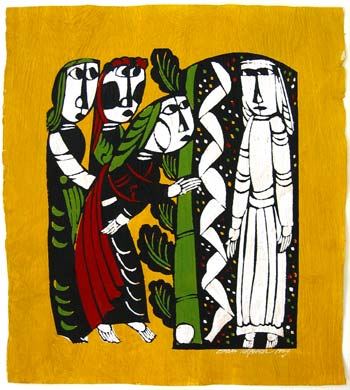
Easter Day: Luke 24:1-12
Sadao Watanabe, "The morning of the resurrection", 1964
 But on the first day of the week, at early dawn, they came to the tomb, taking the spices that they had prepared. They found the stone rolled away from the tomb, but when they went in, they did not find the body. While they were perplexed about this, suddenly two men in dazzling clothes stood beside them. The women were terrified and bowed their faces to the ground, but the men said to them, "Why do you look for the living among the dead? He is not here, but has risen. Remember how he told you, while he was still in Galilee, that the Son of Man must be handed over to sinners, and be crucified, and on the third day rise again." Then they remembered his words, and returning from the tomb, they told all this to the eleven and to all the rest. Now it was Mary Magdalene, Joanna, Mary the mother of James, and the other women with them who told this to the apostles. But these words seemed to them an idle tale, and they did not believe them. But Peter got up and ran to the tomb; stooping and looking in, he saw the linen cloths by themselves; then he went home, amazed at what had happened.
On this Easter morning, with the earth green from yesterday's rain, and the breeze carrying warmer hints of spring, it is hard not to feel like creation itself is pushing us to see resurrection around us. I left home this morning shortly after the start of sunrise. As I drove west toward church, I could see a rich pink sky in my rear view mirror, and I thought to myself, "How lovely that Easter morning could begin with such a beautiful sky." For Easter is always about morning and daybreak after the darkness of night, and about seeing in the world hints of new creation. On this morning, when creation itself sings the praise of the resurrected Christ, I turn to the words of the poet Mary Oliver:
On this Easter morning, with the earth green from yesterday's rain, and the breeze carrying warmer hints of spring, it is hard not to feel like creation itself is pushing us to see resurrection around us. I left home this morning shortly after the start of sunrise. As I drove west toward church, I could see a rich pink sky in my rear view mirror, and I thought to myself, "How lovely that Easter morning could begin with such a beautiful sky." For Easter is always about morning and daybreak after the darkness of night, and about seeing in the world hints of new creation. On this morning, when creation itself sings the praise of the resurrected Christ, I turn to the words of the poet Mary Oliver:
Every morningChrist is risen! He is risen, indeed! Alleluia, alleluia! Thanks be to God!
the world
is created.
Under the orange
sticks of the sun
the heaped
ashes of the night
turn into leaves again
and fasten themselves to the high branches ---
and the ponds appear
like black cloth
on which are painted islands
of summer lilies.
If it is your nature
to be happy
you will swim away along the soft trails
for hours, your imagination
alighting everywhere.
And if your spirit
carries within it
the thorn
that is heavier than lead ---
if it's all you can do
to keep on trudging ---
there is still
somewhere deep within you
a beast shouting that the earth
is exactly what it wanted ---
each pond with its blazing lilies
is a prayer heard and answered
lavishly,
every morning,
whether or not
you have ever dared to be happy,
whether or not
you have ever dared to pray.
"Morning Poem," from Dream Work (1986) by Mary Oliver
12.09.2009
Yes, I write poetry.
In honor of today's first major snow, I thought I'd post a poem I wrote last year while we were still living in the city. The fastest bus home from downtown was a few blocks' walk from our apartment. I wrote this poem after a particularly quiet, snowy night walking home from that bus stop.
After Taking the 147 Bus Home
The circle of the earth,
the dome of the heavens,
the separation of day from night
and dark from light:
all reversed tonight,
heaven and earth exchanged
in a moment of frozen baptism
and utmost freshness.
Deepest brightness of the cosmos
drifts to the soil,
holding its breath,
diving below the heights of heavenly hosts
to mingle with the beagles in the park,
who drag their bellies through the new drifts
and kick up snow like feathers falling.
This is the richest silence;
Spirit and light and air
hovering lightly over
the blanket of the earth
and the notion of the
deafening loudness
of unuttered
grace.
After Taking the 147 Bus Home
The circle of the earth,
the dome of the heavens,
the separation of day from night
and dark from light:
all reversed tonight,
heaven and earth exchanged
in a moment of frozen baptism
and utmost freshness.
Deepest brightness of the cosmos
drifts to the soil,
holding its breath,
diving below the heights of heavenly hosts
to mingle with the beagles in the park,
who drag their bellies through the new drifts
and kick up snow like feathers falling.
This is the richest silence;
Spirit and light and air
hovering lightly over
the blanket of the earth
and the notion of the
deafening loudness
of unuttered
grace.
11.02.2009
NaBloPoMo
>Not that anyone much reads my blog (though if you're on Facebook, all of my posts show up as notes - you can read them there if it's easier!)...
But I love writing, and always have, and probably always will. Even if it's more sermons and blog posts than short stories these days, I'm still a writer at heart. So I'm going to try this out: NaBloPoMo. Why not? It could be fun! Or a disaster...we'll just have to wait and see. :)
But I love writing, and always have, and probably always will. Even if it's more sermons and blog posts than short stories these days, I'm still a writer at heart. So I'm going to try this out: NaBloPoMo. Why not? It could be fun! Or a disaster...we'll just have to wait and see. :)
1.11.2008
Guest Blogging!
I was invited to write a post for Adam's blog, pomomusings, on the topic of the kingdom of God. It's a little intimidating to put your theology out there for many to see, but I'm excited to be a part of the conversation. Thanks, Adam! You can find my post here.
2.25.2007
Must...write...stories...again......
This reminded me that I should start writing creatively again sometime soon:
Kurt Vonnegut: Eight rules for writing fiction:
1. Use the time of a total stranger in such a way that he or she will not feel the time was wasted.
2. Give the reader at least one character he or she can root for.
3. Every character should want something, even if it is only a glass of water.
4. Every sentence must do one of two things -- reveal character or advance the action. 5. Start as close to the end as possible.
6. Be a sadist. Now matter how sweet and innocent your leading characters, make awful things happen to them -- in order that the reader may see what they are made of.
7. Write to please just one person. If you open a window and make love to the world, so to speak, your story will get pneumonia.
8. Give your readers as much information as possible as soon as possible. To heck with suspense. Readers should have such complete understanding of what is going on, where and why, that they could finish the story themselves, should cockroaches eat the last few pages.
-- Vonnegut, Kurt Vonnegut, Bagombo Snuff Box: Uncollected Short Fiction (New York: G.P. Putnam's Sons 1999), 9-10.
Kurt Vonnegut: Eight rules for writing fiction:
1. Use the time of a total stranger in such a way that he or she will not feel the time was wasted.
2. Give the reader at least one character he or she can root for.
3. Every character should want something, even if it is only a glass of water.
4. Every sentence must do one of two things -- reveal character or advance the action. 5. Start as close to the end as possible.
6. Be a sadist. Now matter how sweet and innocent your leading characters, make awful things happen to them -- in order that the reader may see what they are made of.
7. Write to please just one person. If you open a window and make love to the world, so to speak, your story will get pneumonia.
8. Give your readers as much information as possible as soon as possible. To heck with suspense. Readers should have such complete understanding of what is going on, where and why, that they could finish the story themselves, should cockroaches eat the last few pages.
-- Vonnegut, Kurt Vonnegut, Bagombo Snuff Box: Uncollected Short Fiction (New York: G.P. Putnam's Sons 1999), 9-10.
12.13.2006
Six Word Memoir
If you had to write your memoir using only six words, what would you say?
This question is floating around here and here. It is also reminiscent of Hemmingway's infamous six-word story: For sale: Baby shoes, never worn.
But seriously. If you had to write your memoir in six words, what would you say?
My current draft: Chicago girl: seeking home and God.
This question is floating around here and here. It is also reminiscent of Hemmingway's infamous six-word story: For sale: Baby shoes, never worn.
But seriously. If you had to write your memoir in six words, what would you say?
My current draft: Chicago girl: seeking home and God.
10.13.2006
Can you write in cursive?
In high school, I routinely envied my best friend's handwriting. It was small, perfectly round, and adorable. And mine just looked fat and bubbly. But as I've grown into my adult self, and as I can go back through my worksheets, papers, and journals over the course of my education from junior high on up (I'm a pack rat! But not so much that I still have elemtary school stuff hanging around.), I can see how my handwriting has developed into what it is today. And I like my handwriting! I have all of my blue books from exams in seminary. I know exactly what my handwriting is going to look like as I flip through them. The first page is clean, my handwriting small, precise, and standing straight up. And then as you continue through the exam, you will see my handwriting get bigger, start to lean over to one side or the other, and letters run into each other in illegible ways. I love writing in cursive. It's fast, it's pretty, and it's distinctively ME. This is why I sometimes have second thoughts about my identity as a blogger - it would be truer to myself to keep track of my thoughts and experiences in a hand-written journal - which I still do, though not as often as I probably should. I also think that my respect for handwriting comes out of my self-identification as a writer. Writing itself is an intimate act, and handwriting is yet more intimate.
So for all of those reasons, doesn't it make sense that I felt surprisingly sad when I read "Cursive writing becomes passe" in the Washington Post?
So for all of those reasons, doesn't it make sense that I felt surprisingly sad when I read "Cursive writing becomes passe" in the Washington Post?
7.05.2006
Telling the Story
One of the various tools we are using in our CPE group for reflection and self-understanding is the sharing of personal significant stories from our lives. We engage in doing "Story Theology," where we listen to someone's story, discuss our own emotions and associations, and use those thoughts and feelings to connect to an understanding of God's presence, even (or especially) in circumstances when God's presence is not obvious or overt. I'm sharing my first story tomorrow, and I thought that I'd take a risk and be vulnerable in the public eye, so I'm sharing it with you all! It is something that happened to me in college - any Oles reading this blog will remember the circumstances well, I'm sure.
We left the vans in the parking lot of an Econo Lodge at the south edge of El Paso. Three fifteen-passenger vans had carried us from the March chill of Minnesota to the warm desert of Texas. These vans had become homey and familiar to us: for thirty hours we had settled into their soft tan seats, played the alphabet game, listened to music, knitted, read, and bonded over gas station Big Gulps as we drove all the way down Interstate 35. We left the vans in the parking lot and boarded an old, paint-covered bus that would take us across the border into Juarez, Mexico: our spring break destination, not for bikinis and fruity drinks, but for ministry and manual labor.
We left the vans in the parking lot of an Econo Lodge at the south edge of El Paso. Three fifteen-passenger vans had carried us from the March chill of Minnesota to the warm desert of Texas. These vans had become homey and familiar to us: for thirty hours we had settled into their soft tan seats, played the alphabet game, listened to music, knitted, read, and bonded over gas station Big Gulps as we drove all the way down Interstate 35. We left the vans in the parking lot and boarded an old, paint-covered bus that would take us across the border into Juarez, Mexico: our spring break destination, not for bikinis and fruity drinks, but for ministry and manual labor.
The vans had been air-conditioned, carpeted, clean; our living site for the week was to be none of those things. As we bumped along narrow dirt roads full of cars and people, stopping at the “Alto” signs and riding past pink and turquoise storefronts on our way there, I started to feel nervous. Blonde-haired and blue-eyed, I was already obviously a stranger amidst women with thick coffee-colored hair and children with chestnut eyes. But something about the bustle of poverty and pedestrians managed to worsen my feelings of inferiority.
We arrived at our site – a four-building complex built behind a small church, protected on all sides by a brightly painted cinder-block wall – and unloaded the bus. We were the new curiosity to a group of brown-eyed children who had been swinging and sliding on the church playground. They crowded around us, asking for piggyback rides (“Caballito! Caballito!”) and playfully grabbing at Tricia’s baseball cap. This inquisitive gaggle of children followed us around as we toured the entirety of small complex: an unheated dormitory for women with plywood bunk beds in cramped rows, an identical residence for the men, a meeting house with one large common room and a small kitchen with a pass-through window, and a small building with two toilets and two cold showers. The dormitories were padlocked from the outside at all times, and they told us that if we left anything in the showers such as shampoo or soap, there was a good chance it would be stolen. And that was if we even chose to take showers at all, given the low water pressure, the unheated water, and the unspoken group imperative to rough it. As we shuffled across the dust from building to building, the children followed us and peered into doorways from the outside. Those were the rules. They could play on the playground, follow us around outside, but not enter any building except perhaps for the meeting house, but only rarely and with permission. I was secretly glad that they couldn’t follow us into the bathhouse, because then they couldn’t see me wince and blush when our site staff informed us that the plumbing in the area was too weak to support any paper products, and so we would have to throw our used toilet paper into a small garbage can on the floor instead.
I wondered to myself if I would be strong enough to make it through the week. I wanted so badly to be here and to offer myself as a servant to God and to others. But I also wanted so badly to be back on the El Paso side of the border, where I could speak the language, where I could take a warm shower, where there were paved streets and carpeted rooms and buildings with insulated walls. We gathered for orientation in the middle of the common room, sitting on rugs on the packed-dirt floor. Orientation was mostly a series of cautions and warnings. Laura warned us that it was unsafe to leave the complex alone, and that tap water would make us sick, so we could only drink from the blue coolers that were propped up outside the kitchen. She cautioned us against giving gifts to the children or letting them talk us into taking many pictures of them, because it was hard for them to understand that we were only there temporarily. She further reminded us that we had to respect cultural mores concerning touch, meaning that we were to refrain from hugging anyone, even each other, when we were in public.
At this point, all I wanted to do was go home. I already felt lonely and disturbed by our living conditions. I already doubted that I had the strength to have a meaningful week. And now, each piece of orientation information added a new layer of uncertainty to my existing doubts and fears. I was already overwhelmed. Laura finished explaining the rules and guidelines, and then paused. Perhaps she was about to give us a short break to try to get ourselves settled before dinner, I thought. That would give me some time to hide away in a quiet corner and process all of my thoughts. As I scoped out potential hiding places, Laura broke the silence, foiling my plans for escape. She said that she had something else important to tell us. If anyone in the circle felt some sort of fear or premonition over what was about to be said, it certainly wasn’t me.
The announcement came in pieces. The first piece: she had checked her email right before we crossed out of El Paso, and had found there a message from Pastor Benson, one of our college pastors. (I was a sophomore, but for some reason had not yet learned the unspoken fact that college pastors only send out emails when there is bad news to be passed along.) After a short pause, the second piece: five of our fellow students had been driving to New Orleans to do volunteer work over their spring break, not unlike our own decisions to travel here to Mexico. On the way there, in the middle of their first night of driving, a drunk driver entered the highway going the wrong way and had hit them head-on. At this moment, the already-silent room quieted further. We knew that we were about to hear some very bad news. The third piece: three of the five students were killed. “Anna Bonde,” she said, reading from a printout of the email, “Chris Hoppe, and Sarah Heitman.”
Some people sitting near me cried immediately. They formed into small sitting groups of twos and threes, weeping together and clinging to one another. All of the hugging rules were irrelevant at that moment. As for myself, I wasn’t sure how to feel. I guess I knew who Chris was – he was one of the school’s best clarinet players in the band and as such was notorious around the music department – but I had never actually talked to him. And the two girls? I didn’t think I had even met them. Without being friends with any of the three, my grief came at a distance. I wasn’t sure if God was protecting me or deeming me the outcast. Should I feel grateful? Should I feel strong? Should I feel sympathetic? Honestly, I actually just felt left out. I cried a few sympathy tears and felt as if I were observing the whole group – the whole room, even – from someplace far removed. I listened casually as someone from across the room repeated the three names, correcting a mispronunciation. “Ahn-na Bond-ee,” Alex clarified. The name suddenly became too clear to seem real. I saw the name in my head and matched it to the face of a girl who had been in a small and interactive acting class with me. Just as the rest of the group was finishing their first wave of tears and dispersing to find water and tissues, my tears came, late and plentiful.
It was a selfish brand of crying, I knew. Many members of the group had known all three of these students much better than I did. Alex had been in a play with Anna. Heather and Chris had considered dating at one point. I was crying for Anna, but in truth, many of my tears were also my leftover anxiety about the week itself. I had wanted to cry about feeling out of place in Mexico. I had wanted to cry about having to throw away used toilet paper into a garbage can. I had wanted to cry because I had no close friends on the trip with me. These deaths had stirred up in me the tears that I hadn’t yet been able to cry. Amy saw how hard I was crying and came over to comfort me. I let her believe that I was crying about the accident, just like everyone else was. My nose was all drippy, and so she and I stood up to go find some toilet paper in the bathhouse. Before we got to the meeting house door, however, two small sets of brown arms wrapped themselves around our waists. I wonder if Tricia had given them permission to enter, or if they had snuck in on their own. “¿Por qué lloras?” I looked down at a small girl with enormous brown eyes. She hugged me tightly and then pointed to my tears. “¿Por qué lloras?” I shook my head and glanced at Amy. “I don’t understand…I don’t speak Spanish.” Amy looked down at the girls and then back up at me. “They want to know why you are crying.”
I couldn’t give an answer, not in English or Spanish. I could only stand there and keep crying. I was a stranger to everyone, and yet these two children loved me. One of the girls went into the kitchen to find a paper towel while the girl hugging me reached up and wiped the tears from my cheek with her hand. “No llores, no llores,” she repeated to me. She was telling me not to cry. She was telling me that things were okay and that I didn’t need to cry. I don’t remember how long I let these two girls hold onto me and feed me dry paper towels. I don’t remember the rest of the afternoon. I don’t even remember the shape of these children’s faces. But I do remember the big brown eyes that looked into mine and assured me with every blink that things were going to be all right.
5.29.2006
Subculture
Matt and I spent a particularly satisfying evening at Barnes and Noble tonight. While he sat across the table with a cup of ice-water, his own fork for ease of splitting a piece of cheesecake, and the latest collection of Get Fuzzy comic strips, I read fifty pages of Steven Johnson's Everything Bad is Good for You, a holdover from last summer's reading list. This book easily wormed its way into the handful of quirky and interesting books that I find particularly amusing; I have become a sucker for the particular subset of non-fiction that combines economics, sociology, psychology, and popular idiom with anecdotal narrative bits that, while particularizing experience, end up universalizing it. I'm talking about books like Malcom Gladwell's The Tipping Point (or Blink, as well, though I have not yet read it), or Stefan Fatsis's Word Freak, or Steven Levitt's Freakonomics, or Barbara Enrenreich's Nickel and Dimed.
At one point, a friend of Matt's thought it might be amazing fun to immerse herself in the subculture of serious ultimate frisbee - to get to know a choice handful of eccentric and dedicated players and to understand how the world of post-collegiate frisbee functions - and then to write a book in a similar fashion to that of Word Freak. I can't say that the basic concept doesn't interest me immensely: finding a particular subculture in which to immerse myself, meeting the most devoted of aficionados therein, experiencing the nitty gritty and perhaps unexpected details of such a life, and writing a book about it all. Bonus points to me if I can find some sort of socio-economic/psychological undercurrent to it all.
Matt and I ended up talking at length about one subculture of which I am a part that might produce the sorts of quirks and characters worthy of writing about: female fantasy baseball owners. Inspired by his reading of Fantasyland, a look at the extreme characters that emerge within the fantasy baseball world and the intense and intelligent way in which they play the game, it seemed to him like a feasible idea. I could certainly try to track down women who play, perhaps begin a league just for women, market it as an "expert" league, and see what sorts of women show up. I could figure out why women play, and how they play, and what sorts of backgrounds they come from. I could certainly end up finding statistical geniuses, strategy gurus, ritual eccentrics...
All of this makes me step back and take a look at the particular subcultures to which I belong, all of which could certainly be fodder for turning me back into a writer.
I am a knitter.
I am a lover of choral music, and a choir geek also.
I play fantasy baseball. I am a female who plays fantasy baseball.
I am a future pastor. I am a female future pastor.
I have worked in retail.
I have lived in Princeton.
I cook.
I keep a blog (well, a couple of them, to be exact).
I am a PTS alumni. I am a St. Olaf alumni.
I am a Chicago Cubs fan.
And there are so many more. We all belong to our own particular worlds within the larger world. We all belong to particular subsets of people. Isn't this at the root of the popular noun-turned-verb word "networking?" Our subcultures are our starting points. They are the places where we make friends, and the shared experiences that connect us to new people. Our subcultures influence the sorts of people we meet and the sort of people we are. They influence what we consider to be important and the influence the ways that we impact society. They give us value and help us to create value. Along with all of this come the psychological impact of being a part of a group, the economic impact of the way we make decisions based on our perceived return, the sociological and anthropological implications of human interaction, and the dynamic interaction and overlap between individual and shared experience.
Subcultures fascinate me. They make me want to write lots of books. They make me want to be a writer. And I suppose that if I become a writer for real, then that is yet another subculture to add to the list...one that I would be very proud to add.
At one point, a friend of Matt's thought it might be amazing fun to immerse herself in the subculture of serious ultimate frisbee - to get to know a choice handful of eccentric and dedicated players and to understand how the world of post-collegiate frisbee functions - and then to write a book in a similar fashion to that of Word Freak. I can't say that the basic concept doesn't interest me immensely: finding a particular subculture in which to immerse myself, meeting the most devoted of aficionados therein, experiencing the nitty gritty and perhaps unexpected details of such a life, and writing a book about it all. Bonus points to me if I can find some sort of socio-economic/psychological undercurrent to it all.
Matt and I ended up talking at length about one subculture of which I am a part that might produce the sorts of quirks and characters worthy of writing about: female fantasy baseball owners. Inspired by his reading of Fantasyland, a look at the extreme characters that emerge within the fantasy baseball world and the intense and intelligent way in which they play the game, it seemed to him like a feasible idea. I could certainly try to track down women who play, perhaps begin a league just for women, market it as an "expert" league, and see what sorts of women show up. I could figure out why women play, and how they play, and what sorts of backgrounds they come from. I could certainly end up finding statistical geniuses, strategy gurus, ritual eccentrics...
All of this makes me step back and take a look at the particular subcultures to which I belong, all of which could certainly be fodder for turning me back into a writer.
I am a knitter.
I am a lover of choral music, and a choir geek also.
I play fantasy baseball. I am a female who plays fantasy baseball.
I am a future pastor. I am a female future pastor.
I have worked in retail.
I have lived in Princeton.
I cook.
I keep a blog (well, a couple of them, to be exact).
I am a PTS alumni. I am a St. Olaf alumni.
I am a Chicago Cubs fan.
And there are so many more. We all belong to our own particular worlds within the larger world. We all belong to particular subsets of people. Isn't this at the root of the popular noun-turned-verb word "networking?" Our subcultures are our starting points. They are the places where we make friends, and the shared experiences that connect us to new people. Our subcultures influence the sorts of people we meet and the sort of people we are. They influence what we consider to be important and the influence the ways that we impact society. They give us value and help us to create value. Along with all of this come the psychological impact of being a part of a group, the economic impact of the way we make decisions based on our perceived return, the sociological and anthropological implications of human interaction, and the dynamic interaction and overlap between individual and shared experience.
Subcultures fascinate me. They make me want to write lots of books. They make me want to be a writer. And I suppose that if I become a writer for real, then that is yet another subculture to add to the list...one that I would be very proud to add.
11.06.2005
the intrigue
in a former life:
i was a writer.
(and by former life, i mean college...and high school...and middle school...so pretty much forever.)
so i'm pleasantly curious about november being national novel writing month.
anyone trying it? ;) ;)
i was a writer.
(and by former life, i mean college...and high school...and middle school...so pretty much forever.)
so i'm pleasantly curious about november being national novel writing month.
anyone trying it? ;) ;)
8.30.2005
abrupt return from hiatus
just letting you know that i've posted again over at desktop poetry after a long silence. nervous fiction this time.
4.27.2005
inkwell
journaling is the art of the nostalgic-prone soul.
i have this one journal, from my junior year of college, that is as real and beautiful as i like to see myself in that time period. it is a journal full of the usual boy-gossip and daydreaming, but also full of a girl constantly trying to get things right with God, a girl who likes making words sound graceful, a girl who likes to shamelessly reminisce as much as she likes to record the randomness of each day.
i miss that girl.
blogging is nice...and i enjoy it. but it isn't the same as my former journaling self. i don't think that it is merely the private vs. public nature of the crafts. no...there is something about putting pen to paper, something about making a permanent mark, something about the time that it takes to write words down and the magic that happens in that space.
i admit, my life sometimes feels less journal-worthy these days. old journals recorded the excitement of chance boy-encounters, little things that to the adolescent heart became of utmost importance. getting older means mellowing out in that respect: having a different sense of what is "worth" writing about, a different set of things that make you excited...but also higher expectations. as if journaling always had to be profound or emotional. but journaling is a record of days, some exciting, many not. being married, being older, being at seminary: all these are reasons that journaling sometimes seems tedious, since i am asked to do so much reflection during my life as it is that the reflection involved in journaling seems exhausting. and yet all these reasons are why journals should be my best friends. a place to think about being married -- to think about what has changed in me because of it, a place to reminisce about our path to marriage, a place to ask stupid questions and to write down irrational fears. journals are a place to record how getting older is affecting how i look at the world -- the big things that i fear or that bother me, the things that excite me that seem mundane, like unpacking books and starting the move-in process. journaling gives me the space to freely rant at my faith, to question God, to be disgruntled about how distant seminary feels from whatever spiritual self i might want to be.
give me pen, paper. give me ink. let me hear the scratching of the ball-point pen on thick paper. give me back the feeling of a pen in my hand and a book of blank pages balanced on my knees as i unpack the day before turning off the light and curling up with my husband for sleep.
i have this one journal, from my junior year of college, that is as real and beautiful as i like to see myself in that time period. it is a journal full of the usual boy-gossip and daydreaming, but also full of a girl constantly trying to get things right with God, a girl who likes making words sound graceful, a girl who likes to shamelessly reminisce as much as she likes to record the randomness of each day.
i miss that girl.
blogging is nice...and i enjoy it. but it isn't the same as my former journaling self. i don't think that it is merely the private vs. public nature of the crafts. no...there is something about putting pen to paper, something about making a permanent mark, something about the time that it takes to write words down and the magic that happens in that space.
i admit, my life sometimes feels less journal-worthy these days. old journals recorded the excitement of chance boy-encounters, little things that to the adolescent heart became of utmost importance. getting older means mellowing out in that respect: having a different sense of what is "worth" writing about, a different set of things that make you excited...but also higher expectations. as if journaling always had to be profound or emotional. but journaling is a record of days, some exciting, many not. being married, being older, being at seminary: all these are reasons that journaling sometimes seems tedious, since i am asked to do so much reflection during my life as it is that the reflection involved in journaling seems exhausting. and yet all these reasons are why journals should be my best friends. a place to think about being married -- to think about what has changed in me because of it, a place to reminisce about our path to marriage, a place to ask stupid questions and to write down irrational fears. journals are a place to record how getting older is affecting how i look at the world -- the big things that i fear or that bother me, the things that excite me that seem mundane, like unpacking books and starting the move-in process. journaling gives me the space to freely rant at my faith, to question God, to be disgruntled about how distant seminary feels from whatever spiritual self i might want to be.
give me pen, paper. give me ink. let me hear the scratching of the ball-point pen on thick paper. give me back the feeling of a pen in my hand and a book of blank pages balanced on my knees as i unpack the day before turning off the light and curling up with my husband for sleep.
4.03.2005
always darkest before the dawn: reflection on 4am
sunday morning ritual: waking before dawn, before the birds hint at dawn, before night has fully even settled over the earth. baltimore to east windsor. home to church, my house to God's house, my husband to the heavenly bridegroom.
daylight savings time: 4am coming earlier to my poor body. my poor body that loves the feel of a firm mattress and flannel sheets, a down comforter, my husband's body next to mine; maybe cuddling, maybe not, but feeling his presence there. there, where i do not have to sleep alone.
trading bed for interstate: i depend on music and headlights to guide me back from whence i came. some bach for the drive this morning, where the void of night met with the thick blanket of clouds that forbade any sense of light from reaching my eyes. no light from above, no light rising from the road, no flecks of reflection, but only dark. thick dark that felt like the end of the universe. thick dark that hid the rise of the road ahead of me and blurred the lane markers. dark as death.
today: the indecency of loneliness, the dark of four white walls. a day-turned-night of the lonely soul. no light reflecting from me, exuding from me, but only a small girl left wondering at the sad and peculiar world of comings and goings as she waves at the world passing her by.
daylight savings time: 4am coming earlier to my poor body. my poor body that loves the feel of a firm mattress and flannel sheets, a down comforter, my husband's body next to mine; maybe cuddling, maybe not, but feeling his presence there. there, where i do not have to sleep alone.
trading bed for interstate: i depend on music and headlights to guide me back from whence i came. some bach for the drive this morning, where the void of night met with the thick blanket of clouds that forbade any sense of light from reaching my eyes. no light from above, no light rising from the road, no flecks of reflection, but only dark. thick dark that felt like the end of the universe. thick dark that hid the rise of the road ahead of me and blurred the lane markers. dark as death.
today: the indecency of loneliness, the dark of four white walls. a day-turned-night of the lonely soul. no light reflecting from me, exuding from me, but only a small girl left wondering at the sad and peculiar world of comings and goings as she waves at the world passing her by.
3.20.2005
two for the price of one
i love writing. i love theology. i love the fact that they can go hand in hand. i have decided that it is a major life goal of mine to get published. published in poetry or fiction (since i debated doing seminary or a masters of fine arts in creative writing), published in a theological journal, published in any sort of academic journal...i would just love to get myself out there. so here i am, browsing a very brief smattering of journals that might someday want to hear what i have to say. some are academic, some are more journalistic, who knows how "credible" some of these are as "serious" publications...but they seem worth exploring, and at least worth reading now and again:
the christian century
journal for christian theological reserach
listening: journal of religion and culture
the lutheran
theology today
(yay ptsem!)
the christian century
journal for christian theological reserach
listening: journal of religion and culture
the lutheran
theology today
(yay ptsem!)
2.15.2005
melted ice cream is sad
i feel like i have spent the past few days living in a melted state. these past few days i've felt unmotivated, overemotional, lonely, and even paralyzed from doing anything but curling up in bed and taking a nap, and i think that melting is the best analogy that i can come up with. soft and sad like a bowl of ice cream eaten too slowly, or like the last shrinking piles of snow that dissolve when it rains.
i thought about writing a poem about how i feel like a bowl of melting ice cream. and then i decided that the language of melting (softness, drippiness, mushy squishiness) would sound gross and sexual. and so i couldn't bring myself to write the poem. unless, of course, i entitled the poem "this poem is NOT about sex." but i don't think people would believe me.
i thought about writing a poem about how i feel like a bowl of melting ice cream. and then i decided that the language of melting (softness, drippiness, mushy squishiness) would sound gross and sexual. and so i couldn't bring myself to write the poem. unless, of course, i entitled the poem "this poem is NOT about sex." but i don't think people would believe me.

2.01.2005
Subscribe to:
Posts (Atom)